Outside the Frame 間
Ashraf Johaardien: A short meditation on permanence, photographs, and the difference between being known and being seen.
I turned fifty-two this week. The next day was Youth Day, the anniversary of children running from gunfire in Orlando West in 1976. Twenty-four hours apart on the calendar. Last year, around this time, I wrote a monologue for a play called War Stories, trying to imagine what it might have meant to become that photograph.
My birthday itself was a koesisters [sic] and kuier celebration, or more precisely a highly scientific sugar-allocation exercise. Friends brought kids, partners, grandparents, pretty much anyone who could convincingly argue they were entitled to deep-fried optimism. Even an emotional-support pet tagged along. Nobody photographed the moment. The afternoon didn’t need preserving. It existed only for the people standing in the garden eating it, and by Monday most of us will have forgotten the exact shape of it, which is the ordinary and merciful thing that happens to most lived experience.
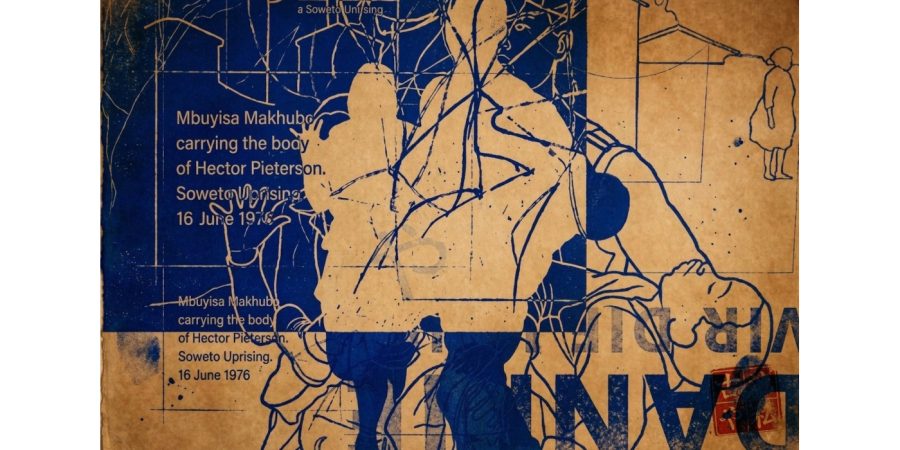
Mbuyisa Makhubo carrying him. Antoinette Sithole running alongside, screaming. A stranger’s shutter clicking at the exact moment a body stopped being a boy and started being an image.
He did not agree to any of it.
He did not sit for a portrait. He did not choose the angle, the light, the precise second the camera caught his head falling back. Someone else’s finger made that decision in the middle of chaos, and the decision outlived him by decades. The photograph is the image South Africa uses to teach itself what 1976 was. It is reproduced in textbooks, murals, documentaries, anniversaries. Hector Pieterson has been frozen at twelve years old for fifty years, recognised everywhere, known by almost no one, because the photograph captured his death and not his life.
The picture made him permanent and erased almost everything else about him in the same instant.
That is the tension I kept returning to while writing the monologue, and the one I still cannot resolve. An image can carry a truth too large for words and still flatten the person inside it to a single frame. Pieterson became a symbol before he had the chance to become an adult. We know exactly how he died. We know almost nothing about what he would have become, what he laughed at, what he was bad at, what he wanted that had nothing to do with history.
I think about this every time a stranger’s phone catches someone mid-collapse and the clip outlives the context by years. A woman shouting at an airline counter. A man being restrained on a train platform. The image travels because a phone happened to be recording, not because it is the moment that person would have chosen to represent them. We call this bearing witness, and sometimes it is exactly that. It can also be a quieter kind of theft: taking someone’s most vulnerable second and making it permanently, involuntarily public.
The question followed me from that monologue into Certainties. It only became fully visible this week, with a birthday and an anniversary a single day apart.
I have two daughters who get to be forgettable in exactly that way. Free to be a different version of themselves by next year. Free to outgrow who they were last Tuesday without anyone holding them to it. Nothing about either of them has been fixed by anything yet. They simply get to keep becoming.
What does it mean to be known forever for the one moment you didn’t choose, instead of the life you were in the middle of living when the shutter caught you?
Outside the Frame emerged from notes written alongside “War Stories” and later “Certainties”. It forms part of an ongoing inquiry into memory, representation, inheritance, and the distance between a life and the image that survives it.
Ashraf Johaardien is a South African writer, artist and researcher. He spends an unreasonable amount of time thinking about language, images, maps and the things people do with them. He writes Atlas Notes at Marginalia + Syntax.
Ashraf Johaardien
flowbook@icloud.com
082 33 95349
Modus Essendi (M\e.)
https://ashrafjohaardien.com
Disclaimer: Artslink.co.za encourages freedom of speech and the expression of diverse views. The views published do not necessarily represent the views of Artslink.co.za.