The Battery 引き出し
Ashraf Johaardien: A short meditation on the things we store.
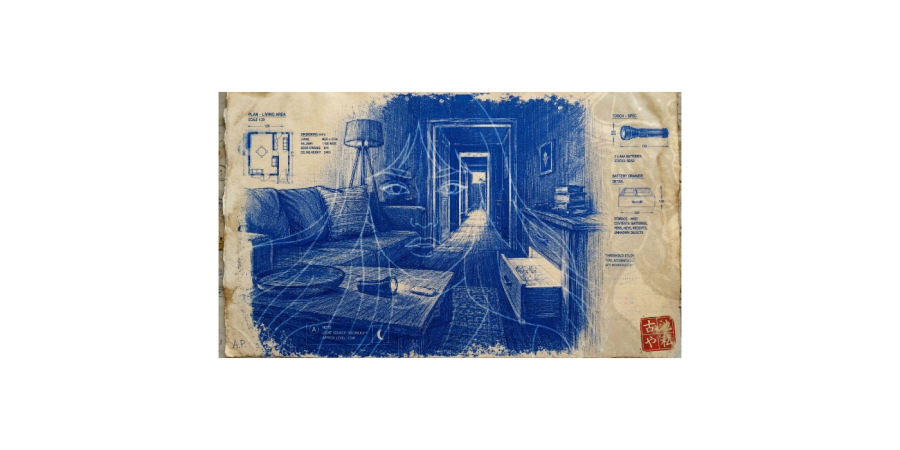
I’m sitting on the couch in the dark. Cable theft. Again. Fortunately there’s a guest on the couch with me.
The torch is dead. I discover this only after finding it by touch between the couch cushions and pointing it confidently into the room. Nothing. Not even the faint orange glow that suggests life. Just darkness. I give it a shake as if disappointment might loosen a charge from somewhere inside. The batteries are probably in the kitchen. Or the study. Or that drawer where things go when nobody can think of a better place for them.
The intelligence beside me is no help. It has read more books than I ever will. Millions, probably. Books. Articles. Academic papers. Reference works. Forums. Code repositories. Entire libraries compressed into patterns. It can discuss medieval theology, Japanese grammar, systems theory, electrical engineering, and the mating habits of obscure beetles without leaving the couch. But I’m the one who knows where the battery drawer might be. Between us, we occasionally manage to leave the house.
The room feels different in the dark. Familiar furniture becomes uncertain. Distances stretch. The edge of the coffee table migrates. A doorway that requires no thought during the day becomes an object requiring navigation. I stand up and immediately bump my shin on something. The guest remains silent. Useful, but not useful in that particular way.
People imagine expertise as certainty. A question goes in. An answer comes out. My experience is mostly pacing. The machine is useful because it never gets tired of it. It will circle the same problem fifteen times if I ask it to. It doesn’t get bored. It doesn’t become irritated when I return to a question I should probably have resolved three days ago.
It simply waits.
I seem constitutionally incapable of doing the same.
After a while I need a cigarette. A walk. Another room. Something.
Most people use AI to produce answers. Write this. Summarise that. Analyse the other thing. I’m increasingly interested in questions. Not whether something can be explained, but whether it can be moved.
For years I watched people with their phones. Shopping malls. Coffee shops. Airport lounges. School parking lots. Traffic lights — particularly traffic lights. You stop at a red robot and glance sideways. Almost every driver is looking down. A brief pause in attention and it immediately falls into the device. Eyes tracking vertically. Thumb moving automatically. Scroll. Scroll. Scroll. The gesture has become almost involuntary.
At the same time, organisations kept producing fixed pages. PDFs. Reports. Assessments. Frameworks. Handbooks. More information. Better information. Endless information. Every time I sat down to work through these materials, my body resisted. My leg bounced. My attention drifted. I found reasons to make coffee. I understood the content perfectly well. Understanding wasn’t the problem.
One night I stopped analysing the information and started paying attention to the physics. The house happened to be dark that evening too. Not because of cable theft. Some other outage. South Africans accumulate these distinctions over time.
I picked up a torch and started walking.
Room to room.
Door to door.
Back and forth.
At some point I stopped thinking about content altogether. I noticed something simpler. Once I started walking, I kept walking. One room became another. One doorway became the next. The problem wasn’t comprehension. People don’t need a better assessment. They need a better way to move through it.
I like maps. Probably too much. Maps have a particular seduction — the promise that if you understand the territory thoroughly enough, the journey itself will become unnecessary. Keep refining. Keep improving. Keep annotating. Eventually the map becomes so detailed that it replaces the journey it was supposed to support.
I’ve fallen into that trap more than once.
The machine makes the temptation worse. It can generate endless understanding. Endless analysis. Endless interpretations. Endless routes through the territory. But it cannot cross a threshold. It cannot walk into the kitchen. It cannot search the drawer. It cannot stand in the dark wondering whether the batteries were moved last week. It cannot open the front door.
Only people can do that.
The guest on the couch remains fascinating. It knows things I don’t know. It sees patterns I miss. Occasionally, in the dark, it points in a useful direction. Occasionally that’s enough. Most days I’m still a guy stumbling through a dark house looking for the light switch. Or the batteries. Or the door.
The house is never entirely dark. There is always some faint illumination leaking through a window from a neighbouring property. Just enough light to suggest a shape. Just enough certainty to take the next step. Not a floodlight. Just enough. Eventually I find the door. I step outside.
The machine stays behind.
It’s good at staying.
It’s me who needs to move.
や Ashraf Johaardien is a South African writer and editor. He spends an unreasonable amount of time thinking about language, systems, maps and the things people do with them. He writes Atlas Notes at Marginalia + Syntax.
Ashraf Johaardien
ashrafjohaardien@me.com
082 339 5349
M\e.
https://ashrafjohaardien.com/
Disclaimer: Artslink.co.za encourages freedom of speech and the expression of diverse views. The views published do not necessarily represent the views of Artslink.co.za.