Highfalutin Failures
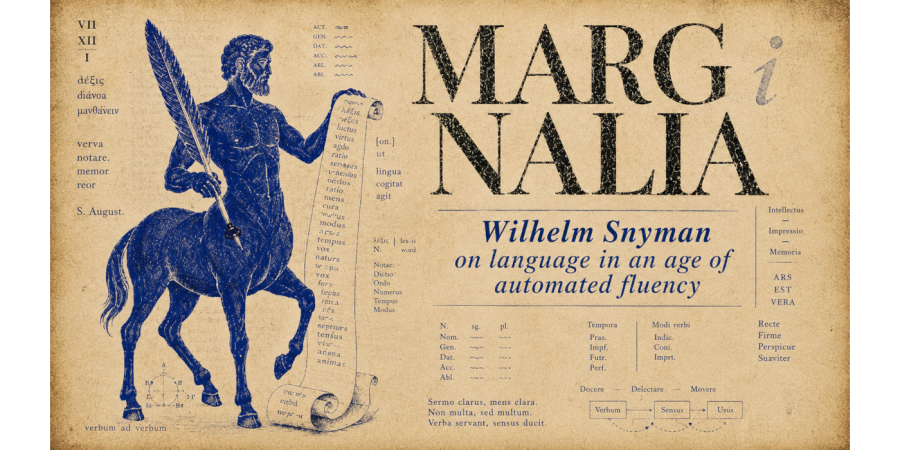
Ashraf Johaardien: Wilhelm Snyman on language in an age of automated fluency. A MARG\NALIA conversation by Ashraf Johaardien.
Wilhelm Snyman is a writer, translator, and scholar of language whose work sits at the intersection of literature, translation, and philology. At a moment when generative AI has made language abundant and instantaneous, Ashraf Johaardien asked him seven questions about authorship, translation, speed, and the future of meaning.
What gains value when words are abundant?
WS: How one uses words; the dexterity in one’s use of language. The imagination that fuels the use of words.
What qualities in writing resist automation?
WS: The individual’s mastery of his or her use of language. Mastery of the medium goes a long way to counter the perils of automation.
If machines can imitate style, where does authorship reside?
WS: [Snyman returns to the principle of mastery: authorship resides not in the unrepeatable self but in the disciplined command of the medium. Style, he implies, is surface; craft is structure.]
What do we lose when we optimise for speed?
WS: Accuracy, imaginative use of language, and much else besides, all of which result in sloppiness and clichés when neglected.
“Translating a novel, for example, is in effect the writing of a new novel. One can only approximate.”
What is always left behind in translation, and why does it matter?
WS: To translate well, one must master the target language so completely that the reader can believe Tolstoy or Dostoyevsky were originally writing in English. David Magarshack, Rosemary Edmonds, Dorothy Sayers, and Jamie McKendrick come to mind as superb translators. Translation remains an act of interpretation, recreation, and literary judgement.
“Philology as a discipline needs to be revived.”
What question about language or meaning are we asking incorrectly?
WS: To translate requires humility in the face of both the source language and the target language; it is fundamentally a philological exercise. Philology as a discipline needs to be revived.
What does language still do exceptionally well that technology cannot replicate?
WS: Technology cannot replicate spontaneity, depth of thought, and the human capacities that animate meaningful language.
What emerges from Snyman’s answers is a defense of language as craft rather than output. In an age increasingly organised around speed, scale, and automation, he repeatedly returns to mastery, imagination, translation, and philology: disciplines that demand patience, attentiveness, and judgement. Whether one agrees with every conclusion or not, the underlying proposition remains difficult to dismiss: language matters not because words are scarce, but because meaning is.
Ashraf Johaardien is a South African writer/editor and illustrator, and the founder of M\e, the home of the Atlas method and FlowBook™. Read more of his work at Marginalia + Syntax on Substack.
Ashraf Johaardien
ashrafjohaardien@gmail.com
M\e.
https://ashrafjohaardien.com/
Disclaimer: Artslink.co.za encourages freedom of speech and the expression of diverse views. The views published do not necessarily represent the views of Artslink.co.za.