Via the R59
Ashraf Johaardien: A brief meditation on the art(s) of going nowhere.
We head south at sunrise.
Me and my twenty-one-year-old Toyota RunX, which is basically a motorised footrest running on optimism and old engine oil. The RunX is the same age as my time in Gauteng. We’ve grown old together. It has 278,000 kilometres on the clock, a passenger door that only opens from the inside if you sweet-talk it, and an air conditioner with two settings: arctic blast straight into your eyeballs, or nothing.
I love it like a difficult relative. Unconditionally, but with frequent negotiations.
The destination is the Klip River, somewhere beyond Meyerton. The plan is simple: find a quiet stretch of trees, sit beside the water and do absolutely nothing. No hiking. No mindfulness journaling. No cold-plunge content for Instagram. Just a man, a river, and a serious commitment to inertia.
It should be easy.
It isn’t.
The traffic is reasonable until a white Quantum appears in the emergency lane, travelling faster than anything has a legal, moral or spiritual right to on a Sunday. Indicators remain more of a bold declaration than a courtesy. You signal that you’d like to change lanes and the car beside you accelerates, as if you’ve challenged it to a duel.
At the Meyerton off-ramp the traffic light is dead. Nobody has told the drivers. Three lanes become seven. I counted. A man in a bakkie leans out of his window and starts directing traffic with the terrifying calm of someone who has decided somebody has to save us all. No uniform. No reflective vest. Just authority. In South Africa, that is often enough. We obey.
I miss the turn-off. My GPS cheerfully announces that I should turn left. There is no left. There is a field and a man selling brooms. I turn anyway.
Eventually I find myself on a corrugated dirt road past a steel yard and three completely unbothered cows. The RunX rattles its way towards what looks suspiciously like someone’s private driveway. A dog watches me arrive. We have an understanding. I am not supposed to be here and he is too hot to enforce it.
Then the road opens. The dust clears. The corrugation gives way to actual tar. Sunlight. Space. Possibility.
It is an on-ramp heading north.
Back to Johannesburg.
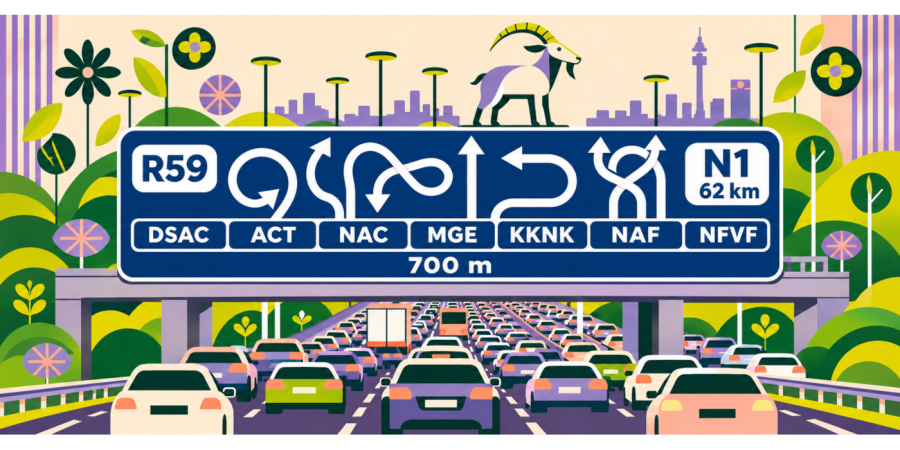
There is a big green sign. N1. Johannesburg. 62 kilometres. It is so cheerful it feels personal.
I sit there for a moment. I have left the city, negotiated its intersections, followed a road that may not have been a road, and somehow managed to point myself straight back in the direction I was trying to escape. A perfect loop. A very South African magic trick.
I recognise the journey. I’ve seen it before. In the arts.
We keep travelling the same roads and wondering why we arrive at the same destination. We change the passengers, announce a new route, occasionally replace the driver. But the underlying system remains remarkably familiar. Perhaps the South African arts sector has simply become attached to going nowhere.
Take the National Arts Council. Each funding cycle, artists and organisations prepare proposals, assemble budgets, prove they’re useful, and wait. The NAC is supposed to be part of the infrastructure that supports creative work. Artists and organisations have described the same delays, administrative problems and shifting processes returning every cycle. We know the potholes. We’ve pointed them out. Then the next round opens and we get back in the car.
The second route leads to the Department of Sport, Arts and Culture and programmes like the Mzansi Golden Economy strategy. Public money matters. Government has a legitimate role, and some programmes make work possible that the market never would. But a programme can hand out opportunities without changing the conditions that keep much of the sector precarious. Artistic freedom and public funding are not opposites. A sector still needs enough independence to negotiate the relationship rather than simply wait for the next intervention.
The third route is the most exhausting. Festivals, independent theatres and community organisations work with shrinking budgets and small teams. The response is familiar: scale down, stretch the team, ask artists to do more, find another sponsor. The festival must go on. The theatre must stay open. Young artists must be developed. Same output, less money, fewer people, more fragile infrastructure.
This is where resilience becomes a convenient word. We celebrate organisations that keep going under impossible conditions. We admire artists who make something out of almost nothing. But resilience cannot be the permanent business model of an entire cultural sector. At some point, asking people to survive conditions that prevent them from flourishing stops being admiration and becomes an abdication of responsibility.
There is a difference between persistence and progress. Persistence gets you back into the car every Sunday. Progress might involve asking why the road keeps taking you home. Even the RunX knows that eventually you have to question the route.
I am not suggesting the arts sector abandon public funding, dismantle its institutions or cancel its festivals. I don’t have a better map waiting in the cubby hole. But we need to stop confusing activity with movement. Another application round is not progress. Another government programme is not reform. And another festival delivered on a depleted budget is not proof of a healthy ecosystem.
The RunX settles back into its familiar 3,000 RPM hum. It sounds relieved. Good. We’re going home. I know how to do that.
Twenty-one years in Gauteng, and I am still trying to get out. I’ll try again next Sunday. Maybe next time I’ll take a goat. Honestly, it probably knows the way better than I do.
Image: Illustration by M\e.
Ashraf Johaardien is a South African writer\artist working across literary, dramatic and visual forms.
Ashraf Johaardien
ashrafjohaardien@me.com
M\e.
http://www.ashrafjohaardien.com
Disclaimer: Artslink.co.za encourages freedom of speech and the expression of diverse views. The views published do not necessarily represent the views of Artslink.co.za.