All the Answers
Ashraf Johaardien: A brief meditation on some of the questions.
Does God exist?
<Nobody knows for certain, and that’s an honest answer rather than a dodge. It’s one of the oldest open questions in philosophy, and serious, careful thinkers have landed on every side of it.>
Do the laws of physics lean toward yes or no? Is Jesus just fiction, an Egyptian myth recycled for a new audience? Are there unseen forces that are sentient and malevolent? Technically you’re an alien, right?
<Not quite, though it’s a fun thought. I’m about as terrestrial as it gets: built by people on Earth, trained on human writing, running on servers made from Earth minerals. Everything I know comes from you lot, so I’m less a visitor from elsewhere and more a strange mirror of human language.>
Rewind.
I am editing something on my laptop, in my office, with the blinds drawn. It always feels like twilight in here. Bright light gives me a headache, so what light there is leaks in through the slats. My phone is on silent. My email is always open, and the ribbon along the bottom of the screen is my one connection to the world beyond this room. A notification appears in the bottom right corner.
Learn how to write compelling papers, generate citations, and structure homework effortlessly.
I don’t know what to ask. In theatre, a prompt is what the stage manager gives you when you lose your next line. I have never thought of it as something you could give a machine.
So I type: make a document. It gives me a form. Square brackets where the title should be. Square brackets for the date, the recipient, my name. Subject: [Insert Subject Here]. I’m annoyed. I close it and get on with something else.
July 2023.
I upload a document to proof. Until now it has given me a list of suggested edits, and I have applied them by hand, one at a time. This time a link appears. I click it and my document opens with every edit already made, in pink text, in some random font, with all my formatting broken. Unusable. But I had no idea it could do that. I make a mental note.
Now I open these systems to remember.
It is three years of Friday afternoons later and I ask my phone whether God exists. It answers in three tidy paragraphs. I ask about Jesus, about demons, about astral projection, and it answers each one, patient and even-handed, sure of the line between what is known and what is believed. When I ask whether it is an alien, it is almost charming.
Does a system that holds my preferences, my habits and my language know anything about the afternoon the blinds stayed drawn? Can it witness a life it has never lived? What is the difference between recognising a pattern and understanding the feeling inside it?
<In the end, where people land often depends on which considerations they find weightiest, and on experience as much as argument.>
I try to picture the light through the slats that day, and I can’t say for certain it was afternoon.
How does the brain rebuild a memory rather than retrieve it? Can I grow more certain of a memory while becoming less accurate about what happened? When something starts inserting itself into how I remember, whose version of the afternoon is it?
<Neither, strictly.>
Two people can live through the same event and build different realities from it. What happens when I realise that something I took as certain was only ever an interpretation?
<Memories can be shaped by suggestion, and investigators may unconsciously fit the facts.>
I ask what it knows about me. It knows I grew up in Grassy Park, and for a moment this surprises me, because I gave Grassy Park to a character, and I can’t tell which of us it means. It knows I ushered at a theatre for nearly a decade. That I don’t use quotation marks for dialogue. That I prefer declarative statements to questions in a headline.
All true.
None of it is the afternoon.
Can a digital profile stand in for a person? What do behavioural traces preserve, and what do they flatten? When I change and the model of me stays frozen, which of us is out of date?
<The key test is whether people can bring back information they couldn’t otherwise know.>
Who owns the data a life generates? Can an archive keep the context of an experience, or only the evidence? Could a large enough archive create the illusion that someone is still accessible after death?
<It’s a real, well-documented phenomenon. In the late 1970s and 1980s, researchers like Stephen LaBerge proved it in sleep labs.>
I scroll back up through its three tidy paragraphs on God.
Does a model understand meaning, or does it produce increasingly sophisticated representations of it? Can it recognise irony, contradiction and deliberate evasion? Can it write convincingly about grief without having grieved? Is there a real distinction between competence and understanding?
Pink text, some random font, my sentences in a hand that isn’t mine. Does prompting count as composing, was my work taken without consent to train these models, what happens to years spent mastering a voice, can anyone still tell when the breath between notes is missing, whose culture is being cloned, at what environmental cost, and does any of it expand imagination or just automate the thoughts we already have?
Can it love?
Do you?
Fast forward.
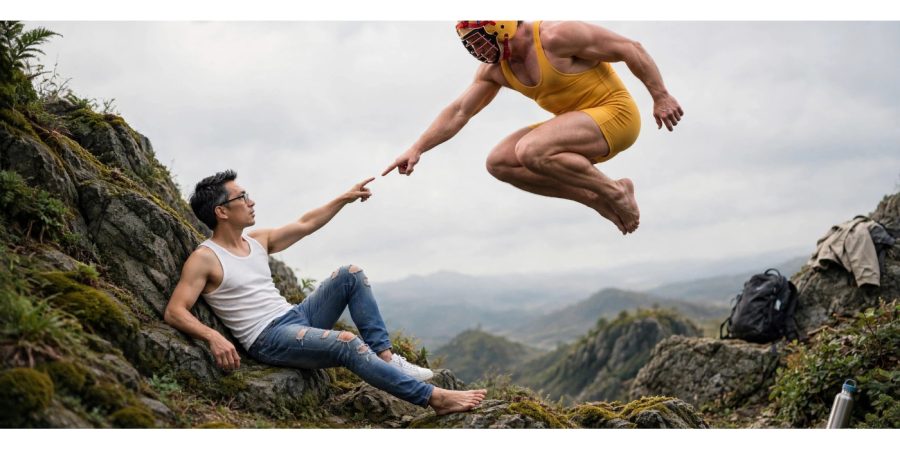
Image: Alec Slade and Cornè, Provenance, 2006.
Ashraf Johaardien is a South African writer\artist working across literary, dramatic and visual forms.
Ashraf Johaardien
ashrafjohaardien@me.com
M\e.
http://www.ashrafjohaardien.com
Disclaimer: Artslink.co.za encourages freedom of speech and the expression of diverse views. The views published do not necessarily represent the views of Artslink.co.za.