Unwrapping the Rainbow
Ashraf Johaardien:A brief meditation on where a queer South African archive survives.
Our timing is good.
We are near the front of the queue when the voting booth opens. The air on 2nd Avenue has an early Highveld bite. Seventeen degrees. The light hits the rocks first. The dry stone shimmers golden yellow. Down here the shadows hold. The still groggy dim world moves slowly, as if reluctant for the daylight to invade.
A phone rings.
I tickle my daughter’s ribs. Why don’t you answer, I joke. She looks back at the owner of the device, a pensioner grumbling something about not being allowed the special vote and ignoring the machine bleating from inside her handbag. My daughter rolls her eyes. I’m not sure if it’s meant for me or the old lady.
The IEC attendants are quick. We are back at the car before the kids can complain. The front passenger seat of the VW is my office for the drive to my in-laws in Kroonstad.
I hit send on a pitch I have been working on.
A new email arrives. For your consideration. The project brief follows. The deadline is in days.
Fine. The machines can help me get this over the line.
I have accounts with five. I outline on my phone, draft in one and send the draft to another for review. The template is a disaster.
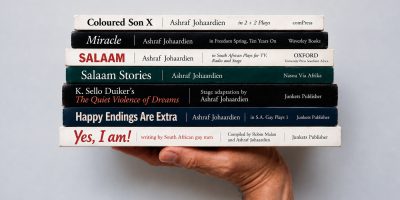
The pitch is for a queer programme across cities and disciplines. One of them confirms three of my works from the files. The Perfumed Closet, a monthly column in The Pink Tongue, 2008 to 2009. Yes, I Am!, an anthology, 2010. “Happy Endings Are Extra”, a play.
It cannot find Reading Gay. #THATSOGAY. #THATSOQUEER. Critically Queer. “The Myth of Andrew and Jo”. “Sando to Samantha”.
Another invents budgets, dates and audience figures. It makes me a curator at the Venice Biennale.
The first calls it out and refuses to use any of it until I can provide Wikipedia-level proof.
The real figures sit with the organisations I worked for. I have none. I stopped keeping posters and printed programmes. They would need their own managed, indexed archive.
I search for the iterations of #THATSOGAY and #THATSOQUEER. The results name Reading Gay as the founding festival. Not inaccurate. I only vaguely remember it. The poster is on the screen. READING in thin letters, GAY in huge ones, both shaded through the rainbow, over two shirtless men with their heads tipped back.
I designed it, in Publisher, at a desk in the old second choir rehearsal room at UJ that stood empty until I had it refurbished. Soundproofed. Rice paper walls. Brown institutional carpet. Light and bright. Through the window students walk up from the boom gate at the Kingsway entrance, past the Arts Centre, towards the main building.
I judge the poster. Very DIY. Embarrassing.
At home, in the walk-in closet next to the window, an old external hard drive waits for a wall socket. When I plug it in it hums the way a modem might, though not the logging on sound. The desk complains about the cooling fan whirring inside.
AJ Archive. Beat Sheets & Outlines. Birthdays. Designs. Drafts. Family. Fonts. Images. Interview Transcripts. Lx Plans. Manuscripts. Miscellaneous. Plays. Publications. Reference Material. Soundtracks and Tech Riders.
Reading Gay is not in any of them.
The Con Cowan Theatre has no seats. Blue carpeted steps and long flat khaki foam pillows, ugly, which I put into storage. We tell the audience to bring a pillow from home. I sit at the back on a plastic chair next to the technical booth. I always sit there. To read the room.
Jade directs “The Boy Who Fell from the Roof”. It is brilliant. Better than the original. The room leans forward, which means it is listening. It laughs on cue. It is inside the world of the play.
During “Happy Endings Are Extra” I do not remember what the room does.
Of “The Myth of Andrew and Jo” I remember all of it. Dublin and Cape Town. A time in my life where I get to be just a performer and not several identities all at the same time. An afternoon nap. A shower. The bus to the theatre in Dublin. The drive to the theatre in Cape Town. Props and costumes set for five full changes in one hour. Warm up. Make up. Focus. The fifteen-minute call. The five minutes that is really ten.
Ladies and gentlemen, stand by on stage please.
In the wings, in the near dark of the blue preset lights, I run my lines. On the other side of the curtain programmes rustle in laps. A whiff of designer perfume. Bodies shuffle into seats. One hysterical laugh always rises above the low chatter. The theatre doors close with dull thuds. Hush. Breath.
The wave of adrenalin laced with cortisol wants to knock me back. I know how to swim through. Dive towards my mark. Find my light. Breathe in. Say the line.
When the lights go down, the sound of rain disguised as hands in the dark.
I carry home relief.
In the same closet the display file holds most of my newspaper clippings in plastic sleeves. Cape Times, Thursday 28 May 1998. Arts and Lifestyle. The headline says Sando about more than drag.
I photograph the clipping in its plastic sleeve and send it.
Under the headline, two photographs. In one I am Sando in a tie, taken at the newspaper’s office where I give the interview. The caption says I play Sando Willemse, the soldier who died of Aids. In the other the caption has me as Samantha Fox, Sando Willemse’s professional other half. A still from the location shoot, in a house in Woodstock.
The people who live there sit across the road with neighbours from up and down the street, watching the whole day while the crew commandeers their home and I perform to the camera as if it is mine. We leave for the next location in the early hours. They are asleep somewhere that is not the house. Like my daughter asleep in the back seat as my husband buzzes the intercom.
Is julle hier?
The register of my mother-in-law’s voice suggests surprise or maybe confusion.
The gate opens.
We are here.
Ashraf Johaardien is a South African writer\artist working across literary, dramatic and visual forms.
Ashraf Johaardien
ashrafjohaardien@me.com
M\e.
http://www.ashrafjohaardien.com
Disclaimer: Artslink.co.za encourages freedom of speech and the expression of diverse views. The views published do not necessarily represent the views of Artslink.co.za.