What the Proof Used to Prove
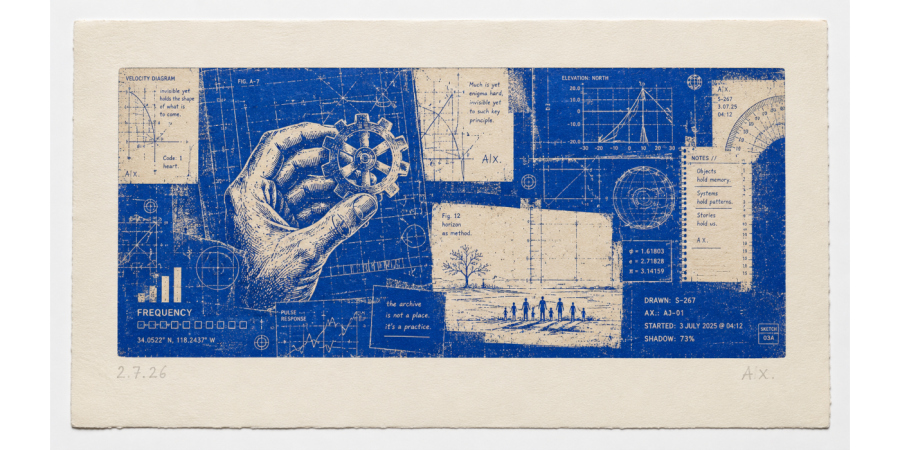
Ashraf Johaardien: If the surface can no longer prove the work, where does the proof go?
The artist’s proof used to mean something specific. The print pulled before the edition. You can see where the acid bit unevenly into the plate. Ink tack still wrong in the lower left corner. Sometimes a fingerprint in the margin from whoever lifted it off the drying rack before it was ready.
These weren’t mistakes. They were the plate still being argued with. The mark of a hand visible not in what was intended but in what hadn’t been resolved yet.
That’s what the proof was for. Not to show technical limitation, but to show a specific mind moving through a specific problem in the only direction available to it at the time. The imperfection was the trace. Surface texture worked as a shortcut to origin because nothing else could produce that particular kind of wrong.
I’ve been sitting with this since Tuesday. Mostly at the kitchen table. Trying to work out what happens to that shortcut once a machine can produce the wrongness too. Most current models resolve toward coherence. Statistical optimisation toward the competent centre. Resolved syntax. Cleaned edges. That’s not a criticism of any particular system. It’s a description of what this generation of tools tends to do. The interesting question isn’t AI in principle. It’s what happens under today’s dominant optimisation regime, and whether asking a model to work in roughness as its native mode actually restores what the proof used to prove.
A model trained to generate roughness would produce something that looks like an artist’s proof without being one. The uneven bite without the acid. The fingerprint without the hand. Performance of the proof rather than evidence of it. That’s where I kept getting stuck. Because what was the proof actually proving? Once a model can manufacture that particular kind of wrong on demand, the thing that used to tell you something stops telling you that thing. The visible trace stops being evidence. The fingerprint doesn’t prove a hand was there. And once you know the mechanism, every institution that has ever relied on reading surface texture as proof of process has to learn to read something else.
That’s a bigger argument than AI and creativity.
It’s a question about how we know that work has actually been worked.
Three days ago, the theory stopped being theoretical. On Tuesday, FlowBook™ went live. Not as a paper standard sitting at a URL. As Fak’ugesi Transmissions. Memory Engines, published to the festival’s Instagram, Facebook and LinkedIn on the 14th. Imagination Engines the next day. Future Engines the day after that. Three Cuts, three days, one visual grammar holding across all of them, built and shipped inside a single working week. I didn’t design that sequence alone at a desk and hand it down. I didn’t design that sequence alone at a desk and hand it down. I built it through an iterative dialogue, arguing with the plate in something closer to real time. The gold hairline running through the design kept disappearing and reappearing at the wrong weight for most of a day before it held. None of that struggle is in the finished Transmissions. The public only sees Memory Engines’ question inverting the archive, Imagination Engines still looking for its sharper reframe, Future Engines closing in three full sentences instead of a list. But the failures are why those three Cuts exist in that form, on that schedule, live on the festival’s channels this week rather than still sitting as an idea. That’s the proof now, not the finished print. It isn’t a retrospective claim about a finished object. It’s sitting on Fak’ugesi’s grid right now, dated, timestamped, published while the argument with the plate was still audible if you knew where to listen for it.
But here’s the problem that doesn’t go away just because the Cuts are live. Publishing three Transmissions in three days, visibly fast, visibly systemised, is exactly the kind of production that gets read as thin. Fast, machine-assisted production still reads, for many people, as the opposite of careful thought. But the roughness that built the architecture for Transmissions wasn’t decorative and it wasn’t hidden. It’s structurally why everyone involved already knows which Cut needs a sharper reframe, and why that knowledge is sitting in the production notes rather than papered over for the launch.
Appearance can no longer prove that. Only the process can. Which means authenticity has moved from the surface into the process itself, and the evidence for it isn’t a fingerprint in the margin anymore. It’s the unresolved sequencing of Cuts 04 and 05, still being argued because the order changes the meaning of the sequence. It’s the details that survive editing because they’re load bearing, not decorative. It’s a launch week that was arguing with itself the whole time it was going out under a visual system still being prototyped.
The more durable questions are harder to sit with. Does it carry something? What does it do to the person receiving it? Is the roughness load bearing or decorative?
This week, something kept arriving in the work I had not explicitly designed. A font that kept failing taught us something about legibility we wouldn’t have learned from a font that worked perfectly. Repeated failed placements eventually showed us that what we needed wasn’t precision. It was permission to let the architecture breathe. And sometimes fail. That’s not a story about FlowBook™ in the abstract anymore. That’s a story about three pieces of festival infrastructure that are live, public, and already shaping how a fourth and fifth Cut get decided.
The artist’s proof was never really about the proof. It was about what the proof pointed toward. A mind. Working something out. That doesn’t disappear when a model learns to stutter. It just stops being legible on the surface, which means you have to go looking for it somewhere else. That’s not about authentication. That’s not about proving the proof is real. That’s about proving the work is alive.
And this week, publicly, it was.
や Ashraf Johaardien writes under the M\e. imprint. He is Resident Writer at the Fak’ugesi African Digital & Innovation Festival.
Ashraf Johaardien
ashrafjohaardien@me.com
M\e.
https://ashrafjohaardien.com/
Disclaimer: Artslink.co.za encourages freedom of speech and the expression of diverse views. The views published do not necessarily represent the views of Artslink.co.za.