Planetary Cognitive Ecologies
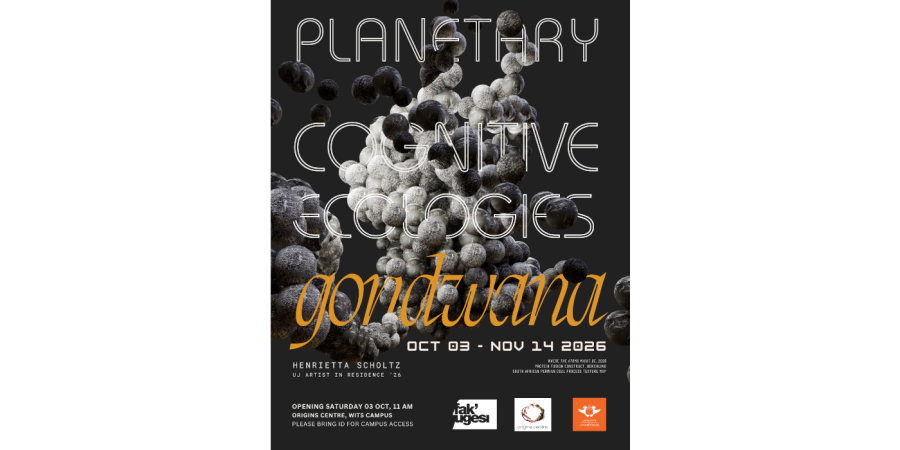
“What survives when a world ends, and what can still be known about it?” asks UJ Arts & Culture Artist-in-Residence, Henrietta Scholtz, in Planetary Cognitive Ecologies: Gondwana, the research outcome of her residency in association with the UJ Art Gallery.
Opening on 3 October 2026 and running until 14 November 2026 at the Origins Centre, the multifaceted, multimedia Planetary Cognitive Ecologies: Gondwana is a research-creation in which the scientific method is the medium where Scholtz explores the boundaries between nature and technology, tradition and innovation, and abstraction and materiality. This exhibition also forms part of the 2026 Fak’ugesi Festival – African Digital & Innovation Festival taking place from 13 to 17 October.
The work finds its beginnings in the research around a species of an ancient plant, Glossopteris. Around 250 million years ago, the forests of Glossopteris began to disappear with the end of the Permian period. The beds of fossilised Glossopteris have become the coal still burned across South Africa, India, and Australia today.
The research draws on the permineralised Permian wood found at Beardmore Glacier in Antarctica and the Lootsberg Pass in the Karoo, where Glossopterid roots sit below the boundary that ends them.
The ancient Glossopteris is extinct. Its fossil record showed what else had been there: a wood decay enzyme. Scholtz uses living versions of wood decay enzymes and living seed plants for the ancestral reconstruction, which she then fuses into one hybrid construct: one half breaking material down, the other survives drying, a molecule that never existed.
Glossopteris is the origin of many things. It made the coal; its distribution across separated landmasses is what proved they had once been joined, and the sites the work draws on are the places its fossils are found. The coal, ground by hand and used as pigment in this exhibition, is Glossopteris, so the plant is in the room as the material it turned into. Ancestral sequence reconstruction and computational protein design are not the subject of the work. They are the material it is made from.
Planetary Cognitive Ecologies: Gondwana resolves into several parts, including Where the Atoms Might Be, a data-driven animated 3D predicted reconstruction of the fusion protein, a virtual reality work, (Ghost Data) LEA: Late Embryogenesis Abundant, and a deposition painting series titled What the Drying Leaves Behind.
In (Ghost Data) LEA: Late Embryogenesis Abundant Scholtz orients the fusion protein’s own structure into the form of a tree, the compact enzyme grounded as its base, the disordered half branching upward from it. Each visitor’s presence draws on one of the ancestral states the evidence could not rule out. The trees accumulate with every visitor, and what forms is a forest that holds decay, possibility, and a record of presence.
What the Drying Leaves Behind is a series in coal, ochre, bio-based inks, and mineral pigment made by deposition. Suspended in water, many possibilities remain. What settles is only one of them, and that becomes the image. Protein exists under the same conditions: water sustains one state, while its loss triggers another. Dormancy is not the end of possibility, but the place where possibility waits.
The work is positioned in line with Karen Bakker’s work on instruments and perception, Laura Tripaldi’s focus on material intelligence and soft technology, and Lukáš Likavčan’s comparative planetology. Showing at Origins Centre places it alongside collections of early human technology and ochre use – on ground that was itself part of Gondwana.
Gondwana’s breaking was catastrophic and generative at once: the same rupture that tore the continent apart drove a fragment into Asia and raised the Himalayas, which are still rising and eroding at almost the same rate.
In constructing a fusion protein that is both ancestral and synthetic at once, Scholtz creates literal and metaphorical interfaces for exploring how technologies can evolve alongside and in dialogue with the natural world. In a present and future that remain uncertain, the work holds disruption and possibility together at molecular and planetary scale.
Planetary Cognitive Ecologies: Gondwana
Date: Saturday, 3 October, and runs until 14 November 2026
Time: 11:00
Venue: Origins Centre, University of the Witwatersrand,
Corner of Yale Road and Enoch Sontonga Avenue, Braamfontein, Johannesburg’
Click here to RSVP – https://forms.cloud.microsoft/r/XnDaU64W84
About the Artist
Henrietta Scholtz is a transdisciplinary artist and researcher working across bio-based materials, computational protein design, and emerging technologies. Her practice develops Bio-Material Translocation (BMT), a framework for thinking through what happens at the threshold, where biological material crosses between physical, biological, digital, and public layers, and what each crossing leaves behind. She works through painting, virtual reality, and computational practice. Her work has been widely exhibited, including at the Forum Création Africa in Lagos, the National Arts Festival, and the Investec Cape Town Art Fair.
About the UJ Artist-in-Residence
The UJ Artist in Residence Programme is designed to perpetuate research through artistic practice, and residencies are available in Visual and Fine Arts, Music, Theatre, Performance and Dance, Design, Film and Television, and Literary Arts. Since its inception in 2022, the programme has supported a wide range of creative projects, including bio-art, music compositions, novellas, documentaries, and theatre productions.
About Fak’ugesi African Digital & Innovation Festival
From 13 to 17 October 2026, the festival returns to the Tshimologong Digital Innovation Precinct in Johannesburg under the theme African Imaginaries.Three frequencies organise the work. Memory Engines: how African communities preserve and transmit knowledge on their own terms. Imagination Engines: how African creatives and technologists are retraining the tools of machine intelligence. Future Engines: how African cities and systems are being built, right now, ahead of global precedent. Each one a distinct signal; together, a system for producing, interrogating, and deploying African knowledge at the highest level of creative and technological ambition.
Lakin Morgan-Baatjies
lakinmb@uj.ac.za
011 559 1315
University of Johannesburg Art Gallery
https://arts.uj.ac.za/whats-on/henrietta-scholtz-in-planetary-cognitive-ecologies-gondwana/