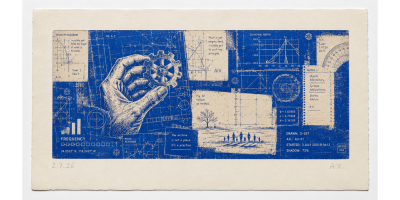
The Publisher is Dead. Atlasing with FlowBook™
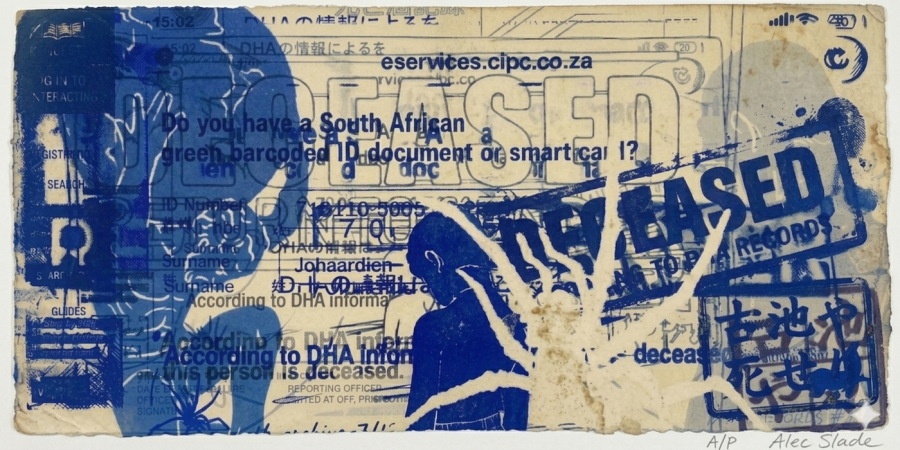
Ashraf Johaardien: A short meditation on bureaucratic death, classification systems, and the naming of things.
I log into the CIPC portal to register a trademark.
The portal informs me I am dead.
Not metaphorically. Not in the creative exhaustion sense. Officially. According to the Department of Home Affairs, I have ceased to exist. I check the ID number. I check the surname. I check for other signs of death. Everything appears to be functioning normally. Except, apparently, me.
The irony is difficult to ignore. I am attempting to register a trademark for a publishing format designed for the future. The system has already filed me under the past.
I push on.
The next error: my ID number is already registered. No problem. I will log in. The password does not return. No problem. I will reset it.
The reset function appears to exist in the way abandoned infrastructure exists. Formally present. Practically inaccessible.
Dead links. Dead credentials. Active records pointing nowhere. Every reference number remains. Every pathway leads to silence.
This is where the real structure becomes visible.
Before I have even reached publishing, I have entered classification. And classification is always older than the thing it claims to describe.
I have started calling this atlasing.
An atlas does not describe a system. It reveals what carries it. The atlantes were sculpted figures used as columns in place of pillars. Human forms bearing architectural weight. Not decorative. Structural.
To atlas something is to ask a simple question: what is actually holding this up?
The system I am dealing with appears to be a registration portal. Atlas it and it becomes something else: an identity system built on permanence assumptions. That people remain stable. That accounts outlive transitions. That the present is legible to the future.
Publishing is no different.
Atlas publishing and you do not find books at the centre. You find the page. A rectangle that survived every technological shift by pretending to be neutral.
It is not neutral. It is a set of decisions about how thought should move, how time should unfold, how attention should be structured.
Those decisions worked for a long time. They are now quietly mismatched to the devices we actually read on.
We have spent years adapting books to screens without questioning whether the book was the correct unit in the first place. PDFs became digital books. Ebooks became simulated pages. Interfaces inherited margins they no longer needed. We carried print logic into a medium that does not behave like print. The problem was not resolution.
It is form.
The page assumes stillness. The phone is continuous motion. The page has edges. The phone has a frame through which content passes. Each time we force page-logic into scroll-logic, we are asking a different structure to carry the wrong weight.
FlowBook™ begins here, but not as a product.
As a question of form.
What if reading on a phone is not a degraded version of reading, but a different architecture entirely? What if scroll is not a workaround for pages, but a structural principle in its own right In a FlowBook™, sequence is not inherited from pagination. It is constructed. Spacing is not decorative. It is temporal. Delay is not absence. It is part of meaning. The frame is not a container for pages. It is a field through which language moves.
FlowBook™ is what emerges when atlasing is applied to publishing. It is not a container for content. It is the form content resolves into when it is no longer forced through templates, marketing categories, file formats, or device constraints.
The underlying structure is simple: the page is no longer the primary unit of reading. Everything else follows from that.
Most systems do not reject new ideas directly. They fail them indirectly. They misfile them. They lose them in expired credentials. They route them through structures designed for things that already exist. The future rarely breaks systems. It gets classified out of them.
The CIPC portal eventually accepts the claim.
Not because it understands it. Because it has somewhere to place it. This is no longer my problem. Or rather, it is now only my problem in the way all systems eventually become someone else’s maintenance task.
What remains is the question beneath the process. Before you can change a system, you have to see what is carrying it.
That is atlasing.
The hidden figure beneath the weight. The structural assumption disguised as infrastructure. The thing that allows everything else to stand.
The publisher is not dead. It is waiting on a classification it was never designed to recognise. And the page is still standing, quietly holding up a form of reading that no longer quite fits the way we live inside screens.
FlowBook™ is not an answer. It is a way of looking at what has been carrying the weight all along.
Ashraf Johaardien is a South African writer and founder of M\e. Read more of his work at Marginalia + Syntax* on Substack. The Tailor’s Daughter by Xeenit Smith is published July 2026 by Proof Press, a M\e. imprint, as the first FlowBook™ Edition.
Ashraf Johaardien
ashrafjohaardien@me.com
M\e.
https://ashrafjohaardien.com/
Disclaimer: Artslink.co.za encourages freedom of speech and the expression of diverse views. The views published do not necessarily represent the views of Artslink.co.za.