In Every Book
Ashraf Johaardien: A brief meditation on invisible mending.
The study is dim.
I keep the blinds drawn. The tile on the wall to the right of my desk gathers what little light there is.
I search for the address of a fine art printer. The place in Cape Town I wrote to last year. I want to ask for a quote for the print edition of “Monkey Mind”. Forty-four of the fifty-two pieces are out in the world. Eight remain, and this is one of them.
I type print. Or printing.
The search returns my Junkets folder. In it an email from Robin Malan that I have never opened. 26 February 2022. Junkets was his imprint. Robin died in September 2024. I believed I had laid him to rest on 27 October, in a piece for Artspoken. For a moment the room does not agree with itself. A glitch in the matrix, and then it settles.
“Inscapes”, the 1969 edition, lives in our house and goes with me to school. Often. “Inscapes”, 1986, comes with me to boarding school in Wales. “Worldscapes”, 1997, still stands on the shelf among the books from varsity. I read Robin’s name on those spines for years before my English teacher at boarding school mentions she knows him at Waterford Kamhlaba, where he is vice principal. When I finally tell him, he laughs, generously, from the liver. He has heard it from hundreds of school-goers by then, and he laughs anyway.
2012. I go to Mowbray to collect books, to the house that belonged to the Aunts. I cannot say which books. Playscripts for the arts and culture division at UJ, perhaps, or author’s copies, or an anthology with one of my plays inside it. He is my publisher. He is also my friend and my mentor, in whatever order the day requires.
My father is a tailor. I grew up watching him do invisible mending. Thread laid so close to the weave that the tear disappears and so does any sign that someone was there. Robin edited the same way. We sat side by side over a manuscript and I could not find what had changed.
What I learned at his elbow is how to assemble a book like a house. The foundation is poured and left to cure before a wall goes up. Floors, ceilings and plumbing go in before the roof. It is the labour of a building site.
Every month I bought “Exit”. Every month, without being asked, Robin emailed me the text of his column, “Young Gay Guys”. I did not need the emails. I had the paper. He sent them anyway, month after month. About thirty are still in my inbox. Of the paper, only one copy remains, issue 186, October 2005, and on page 18 he answers three letters. A reader in Gauteng wants brochures of men’s underwear and is told this is not that kind of column, with thanks for reading. A nineteen-year-old in Grade 12 on the South Coast is told to enjoy being young and gay. A sixteen-year-old signing himself Little Stabani is told that the first step in coming out is the thing he has just done. Robin signs off, be strong and be proud.
In August 2011 he tells me about a stent, a stainless steel tube in a narrowed artery, and says it will last forever. And so, perhaps, will he. On 4 April 2012, at half past five, I wish him happy birthday. His birthday is a week away, on the eleventh. Before dawn I catch the mistake and apologise, borrowing a line from “Hamlet” about having no art to reckon numbers, admitting I am more than a bit deurmekaar. Mid-morning he writes back that a couple of days early is fine, when it is a full week, and that the wishes will linger longer. From 2013 he returns the favour. In eight of the nine Junes up to 2021 he remembers mine, and twice he is late and says so in the subject line.
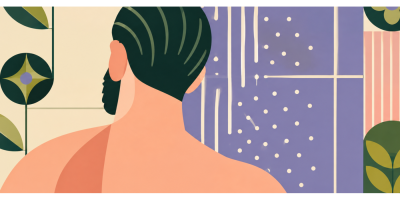
The tile arrives when Robin is clearing out and his sister Daphne is moving in. He hands it over without ceremony. I kept this for you, he says. I say thank you. It is a squared porcelain tile, a Japanese painting of a geisha, her dark hair seen from behind, one hand at her neck, her face given only in a small round mirror near the lower left corner. Black script runs down the pale green ground. A white box frame holds it a little off the wall, so it throws a small shadow. Of all the pieces I own, it is one of my favourites.
My trips to Cape Town grew shorter and fewer as the girls got older, and I dropped by less and less. I am not the greatest email correspondent and the numbers say so. Life gets busy the way life does and the years pass the way years do. We spoke on the phone in February 2022, a catch up I only vaguely remember. I know he has not been well.
In the archive there are three hundred and forty-two threads from him and I write in thirty-one. Robin writes.
Afterwards he writes to me at length about “Karaoke and Doekie Monsters”. He says he cannot fathom how my imagination works. He wants to know how he can publish this play.
I open it. Dear Ashraf. Robin is at his desk, elbows on the table, my play printed out in front of him. He dozes off every now and then while reading, he says, and wakes with the dreams gone.
I write back.
Dear Robin,
That’s lovely, thank you. It’s likely to change before and during performance so let’s pick up the publishing conversation when/if that happens.
x
I do not hit send. I leave it exactly as I typed it.
I crack open the blind and light hits my screen in the shape of the bookshelf behind. I swivel my chair around and walk towards it. Run my fingers over the spines.
He’s here.
In every book I touch.
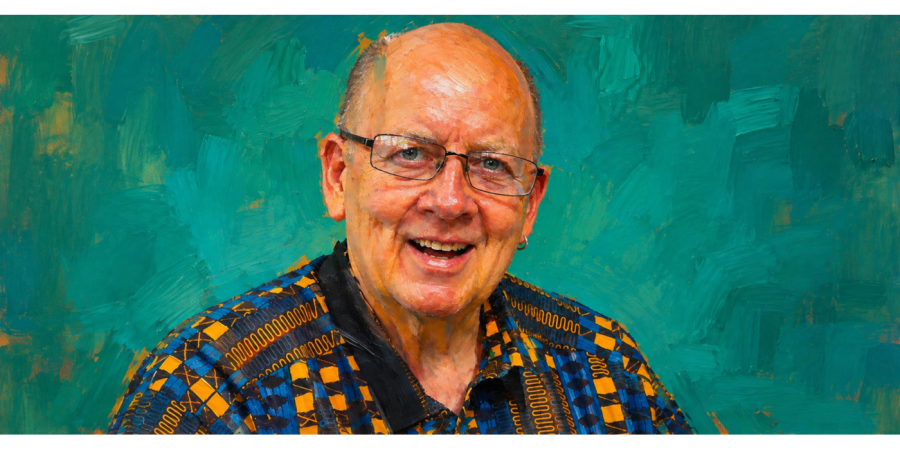
Image: Portrait of Robin Malan by M\e.
Ashraf Johaardien is a South African writer\artist working across literary, dramatic and visual forms.
Ashraf Johaardien
ashrafjohaardien@me.com
M\e.
http://www.ashrafjohaardien.com
Disclaimer: Artslink.co.za encourages freedom of speech and the expression of diverse views. The views published do not necessarily represent the views of Artslink.co.za.