The Black Ball
Ashraf Johaardien: “Que no demos más bolas negras.” On Guitarricadelafuente, St Sebastian, and who gets to hold the ballot.
Platō.
Nine Yards in Rosebank. A near-naked classical figure. In denim jeans. Of course I stop scrolling. I’m waiting to meet the playwright I’m mentoring. I click the link and watch while I wait.
Smoke first.
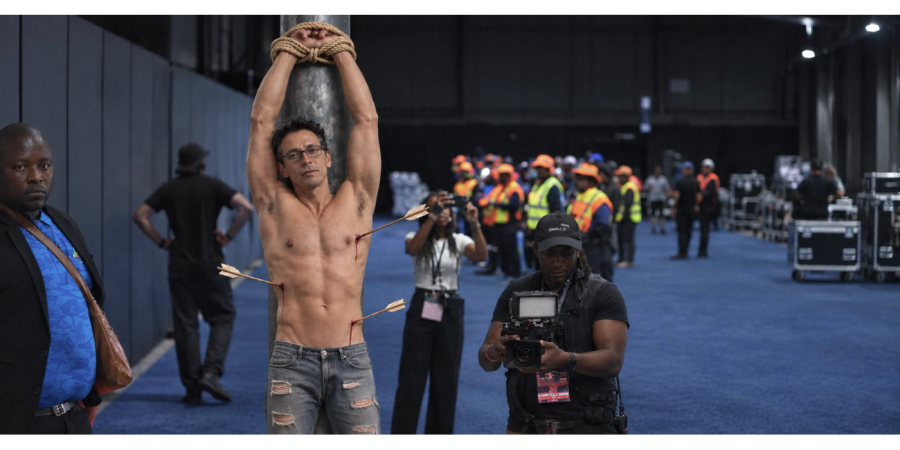
Then a shirtless man, hands bound to a post. Before anyone sings a note, the arena is given an image it already knows how to read. St Sebastian, tied and waiting for the arrows.
Guitarricadelafuente sings La Nieve from inside that image. Then he frees himself, puts on a sequinned coat and launches into Babieca!. The martyr steps out of his own martyrdom and goes straight into the show. The audience has to decide what, exactly, it has just applauded.
A few minutes later Rosalía presents him with the Premio Especial Fenómeno Cultural del Año at the LOS40 Music Awards Santander. She says there are many Sebastians in the world and that he gives them a voice. She mentions La bola negra at a moment when so much is being questioned, with a general election a week away.
He says he’s proud to belong to a generation of artists with different outlooks. Then he delivers the line that gives the evening its sting. Que no demos más bolas negras. Let’s not hand out any more black balls.
The black ball wasn’t originally a metaphor. English has had the verb blackball since the 1770s. It comes from the dark balls members dropped into an urn to vote someone out of a club. Spanish parliamentary procedure used white and black balls the same way, one for acceptance, one for refusal. Dar bola negra is what you do with the second one. The device is secret. It requires no explanation. Nobody has to look the rejected person in the eye. In some clubs, one black ball was enough. A kind of democracy, but with a guest list.
So when Guitarricadelafuente says we, he’s speaking the language of membership. The question isn’t whether we should all be a little kinder. It’s who gets to hold the ball.
The film gets this. A young man applies to enter an exclusive social club and the black balls fall against him, one after another. Its makers, Javier Calvo and Javier Ambrossi, developed the project with playwright Alberto Conejero from the few pages Federico García Lorca left of an unfinished play of the same name, begun in early 1936, the year he was killed. Three lives are woven together across 1932, 1937 and 2017. In the middle story, Sebastián, a young soldier fighting on the Francoist side, falls for Rafael Rodríguez Rapún, a real person and the last known love of Lorca. Sebastián is invented. The machinery around him is not.
La Nieve carries that history further. Guitarricadelafuente has said the song draws on Lorca’s final letter and on Sebastián, with snow as a figure for the end of a journey and for death. So the image travels. From an unfinished play to a film to a song to an arena. Less a rescue operation than a genealogy.
And the room knows that lineage. St Sebastian has had a long queer afterlife. Oscar Wilde took the name Sebastian Melmoth after prison. Yukio Mishima posed as the saint. Derek Jarman made Sebastiane. Dalí wrote San Sebastián in 1927 and dedicated it to Lorca.
A man martyred for his faith becomes, in art, a beautiful young body. The image that protests violence can also make violence pleasing to look at. The arena admires the martyr, then watches him emerge in sequins. He doesn’t stay tied to the post. He releases himself. That looks like liberation. It’s also entertainment. Mainstream recognition is good at buying that kind of moment.
An awards ceremony is a ballot of its own. A club ballot decides who is allowed in. An awards ballot decides who is recognised. Categories, nominees, winners, a room full of people deciding who’s remarkable. A special award sits outside the competition. A convenient place from which to declare someone a cultural phenomenon. The room’s power to recognise is inseparable from the interests that pay to stage it. Somebody pays for that ballot. That’s how much of the arts gets funded. When I wrote a report on twenty-five years of business backing the arts, the biggest sponsors in the year I examined came from the financial, media and entertainment industries. Not a scandal. Just a structure.
I’ve held a ball myself. I once said in an interview that not every business was a fit and that the right partners had to be found. I oversaw a fund. It backed projects that already had relationships with businesses. I meant it as strategy. It was also a door policy. A major book festival with a solid track record is approved for support. On condition their business sponsor signs up for membership. A strong-arm manoeuvre I introduced to drive membership numbers. The partner refuses. That year the festival doesn’t happen. I understood the logic. I knew who it shut out.
The ceremony gave this history a mainstream audience, and the speech that followed named exclusion as the subject. That matters. But a prize for a film about repression doesn’t repeal the repression. Rosalía’s remarks about defending rights point towards what the film insists on. What was once refused can be refused again.
The urn isn’t only in Madrid. In Johannesburg after the municipal elections, the party with the largest share of the vote was told by a prospective coalition partner that a way into government might open if its mayoral candidate stepped aside. The black ball was dropped in public. That was the only difference.
Now go back to the phrase. Que no demos is a plea in the first person plural. It doesn’t say they. Not the old regime, not the bigots, not the men with the urn. It says we. The industry, the audience, the speaker himself. That makes it a confession as well as an appeal. We have handed out the black balls. We can stop.
Except the request is also modest. It asks us to stop using the instrument of exclusion, not to dismantle the institution that gives anyone the authority to use it. The urn remains on the table, available for the next membership meeting.
That’s the wit in the line, and its limit. A standing ovation is a white ball, but it’s still a ballot. The harder question, the one the film’s falling black balls leave us with, is who built the urn. And who decided that strangers should have the authority to vote on whether someone gets to come in.
The post was still on stage after he left it.
Empty.
Lit.
Waiting.
Image: Backstage at the Ball, 2026. Model: Alec Slade. Text-to-image synthesis, digital collage and inpainting.
Ashraf Johaardien is a South African writer\artist working across literary, dramatic and visual forms.
Ashraf Johaardien
ashrafjohaardien@me.com
M\e.
http://www.ashrafjohaardien.com
Disclaimer: Artslink.co.za encourages freedom of speech and the expression of diverse views. The views published do not necessarily represent the views of Artslink.co.za.