
Orange You Glad?
Ashraf Johaardien: A brief meditation on the unfunny of the POTUS.
I pay my TV licence.
Every year.
Reluctantly.
Twenty-one years in Johannesburg, dutifully, because they threaten to blacklist you, and I have never once got SABC on my television. I’ve moved house and television more times than I can count. I pay. They broadcast. Somewhere, presumably, to someone.
So I only found The Apprentice six seasons in, once it moved to DStv. I was late to the boardroom. Donald Trump had been firing people on television for years before I arrived.
My phone pings. Julien, my mate from boarding school. He’s in Paris. He lives in West Hollywood. He’s a Democrat.
Hello darling. Let’s go clubbing tonight.
I reply with the appropriate seriousness.
Hey Mr America. I see your team made big gains in the November midterms. What should I wear?
Nothing.
Silly, silly man.
I have no vote in America, but I wonder whether the boardroom was a rehearsal.
Trump was not running the same race as everyone else. The others offered themselves as better managers of a machine they considered basically sound. He offered himself as the verdict on the machine. It was rigged, he said, and he was the proof it could be broken. When people stop believing the system is legitimate, the promise of better management becomes a thinner offer than the promise of rupture. That is my reading, held as interpretation.
For someone who already feels the system has stopped working, competence is not enough. The reasons vary, deindustrialisation, cultural change, endless wars, Washington as a closed club, the simple sense of standing outside the room. They don’t belong to one group. What they share is the difference between wanting a better version of the machine and wanting to reject it. A manager can only answer the first. A wrecking ball answers the second.
He understood theatre. On The Apprentice, authority was made visible by firing someone. A desk, a boardroom, anxious faces, a verdict. No committee. No consultation. The music swelled. We went to an advert.
That performance became a style. The ordinary liabilities should have cost him, the crude behaviour, the lawsuits, the impeachment. Among people who already saw him as an outsider, they could do the reverse. If the political and media establishment opposes him, the opposition itself can become proof that he threatens it. Accountability does not vanish because a politician calls it persecution.
He also understood the feed. Instead of message discipline, he floods it. The media spend the day correcting what he said, and by evening he has moved on. A message can be controlled. The conditions of attention can be controlled. The frame through which an event is read can be controlled. Flooding works on the second. The real contest is over the third. It’s like setting off every fire alarm in the building. Soon nobody can tell which one is real, and the audience is left asking whether there is a fire, whether there ever was one, and whether the person reporting it is on the payroll of the fire brigade.
The feed accounts for one mechanism. The grievances were already there.
In the thread I have been following, one person announces a restoration. We are back. The replies do not dispute the evidence. They refuse the premise and install their own, with AIPAC, institutional capture and fraud as competing explanations. Nobody persuades anybody. The first frame is never established. It is overwritten. A handful of people on a feed is an illustration, not a sample.
There is a larger proposition behind it, and it needs qualifying. The old map set business and religious conservatives with the Republicans, and unions, progressives and minorities with the Democrats. A different line may be forming between non-college voters who distrust institutions and college-educated voters who retain more confidence in them. The arguments about AIPAC, the swamp and election fraud look separate and may be one question. Are American institutions legitimate, or captured and in need of tearing down?
Trump has planted his flag on the second answer. Once that diagnosis is accepted, policy, personality and even the criminal cases begin to recede. They remain real. They lose their power to decide, because they arrive as verdicts from a court the voter no longer recognises. He did not necessarily invent the grievances. His skill was gathering them under one explanation, with himself as the instrument. Some people may be choosing between rival accounts of reality more than they are choosing platforms. You don’t have to agree with everything he does. You only have to believe he understands what has gone wrong.
Which leaves the contradiction. What happens when the movement that gained power by delegitimising institutions becomes responsible for governing them? Disruption can win an election. It is not a governing philosophy. You can fire the people who were there before you, but the building does not become self-managing.
Even the wrecking crew needs a facilities department.
Whether a politics built on permanent opposition can govern without rebuilding the structures it rejected, or must keep finding new enemies to remain itself, I don’t know. I distrust anyone who claims to.
I think again of Julien. We tease each other about teams and elections, then go back to arranging the night. We share enough of a reality to disagree without establishing whether the other is living in the same one. Between the person who says we are back and the one who says the country was captured, the gap is over what has happened, and neither of them is arranging a night out. A democracy can live with disagreement about what should happen. It is less clear what survives disagreement about what is happening, when the courts, the press and the count itself are trusted in one country and suspected in the other.
I am less sure America can do what Julien and I do.
And I still cannot get SABC.
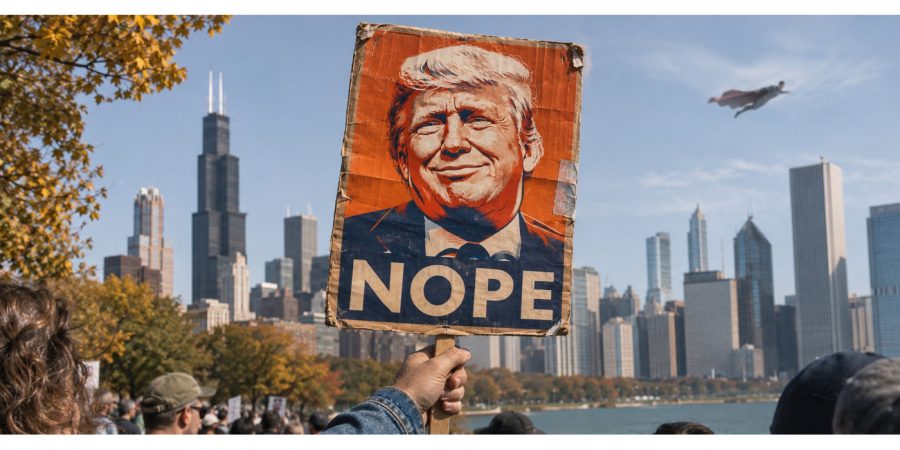
Image: Composite after a photograph by Stephen Leonardi, 2025 (recoloured, background changed, figure added).
Ashraf Johaardien is a South African writer\artist working across literary, dramatic and visual forms.
Ashraf Johaardien
ashrafjohaardien@me.com
M\e.
http://www.ashrafjohaardien.com
Disclaimer: Artslink.co.za encourages freedom of speech and the expression of diverse views. The views published do not necessarily represent the views of Artslink.co.za.