
From Algorithm to Invoice
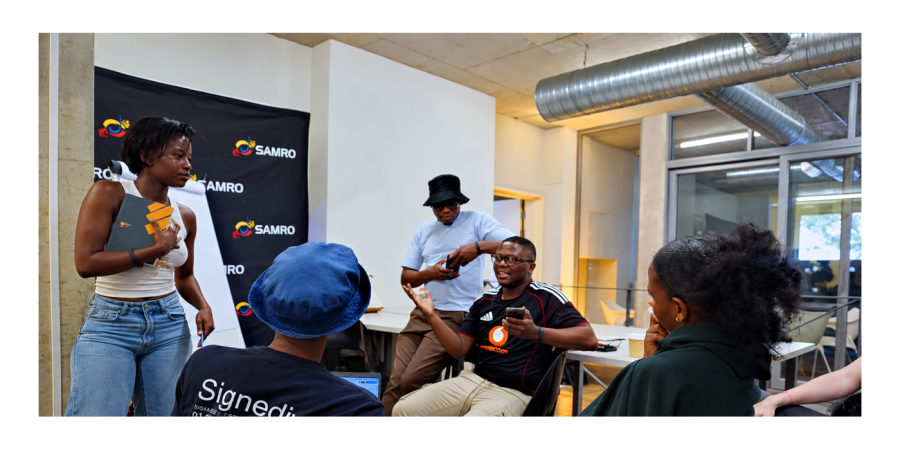
Ashraf Johaardien: Real industry challenges, practical solutions and a pitch day: how a multidisciplinary Wits hackathon puts AI and data to work for African music.
A song can cross a border in seconds. The contracts, royalties, discovery systems and finance around it still move at the speed of institutions.
That gap sits inside the festival’s third question. Fak’ugesi 2026 runs from 13 to 17 October across Wits Braamfontein under three questions: what survives, what is intelligence, who builds the future. The third is the practical one. The festival calls it Future Engines. This is where an argument has to become a plan. The AI & Music Business Hackathon began on Tuesday 13 October at the Accelerator at Tshimologong Digital Innovation Precinct and runs for four days. Today is the final day.
The question is straightforward: how might AI, data and emerging technologies unlock opportunities for people, businesses and communities across Africa’s music ecosystem? The programme focuses on the structures that decide whether a song, and the person who made it, can sustain a living.
Teams come from business, finance, rights, legal, technology, research and entrepreneurship, alongside artists and music professionals. The mix is deliberate. A rights framework needs a lawyer, a data model and a revenue forecast before it needs an algorithm. A promising tool needs someone who can read a balance sheet.
Artist income is often the least predictable number in the chain. The capital that could steady it sits behind a gap in trust and information. Most current efforts try to make existing deals run a little better. The open question is whether the financing model itself can be redesigned.
Rights data and royalty systems are the unglamorous infrastructure. When they work, nobody notices. When they fail, the money stops. A rights system could instead be built around how information actually moves, rather than simply speeding up the current one.
Discoverability, audience development and industry efficiency are linked. The problem is how a song finds the people who would pay attention to it, and how much of that work is still done by hand. Discovery can be treated as a design problem for the whole ecosystem, not just the recommendation engine of one platform.
Copyright and AI is on the table and matters. The harder issue is which business models become possible once data, rights and discovery are treated as core systems rather than afterthoughts. A system that can move a royalty accurately and show where it went is a different industry from one that cannot. That is the territory the teams are working in.
Kerryn Campion, Chief Operating Officer of Aions Ventures, facilitates, drawing on her work in entrepreneurship development and venture building. Her task is to take a team from first concept to an idea tested against the market. Students from the new Wits Master’s in Financial Technology work with each team as innovation research partners, contributing market intelligence, opportunity mapping, future-scenario analysis, business-model development and data analysis. That keeps the work market-facing and evidence-based.
The work ends in public today. From 11:30 to 13:30, selected teams present to investors, labels and platform partners in the AI & Music Business sessions of the Pitchathon Marathon at Tshimologong. An idea that cannot answer questions from people who control capital or catalogues has not yet solved the problem.
The programme is hosted by the Wits Innovation Centre and the MIND Institute, with support from SAMPRA and SAMRO.
Elsewhere in the festival, AI, sound, gaming, film and immersive work ask who builds the systems that shape culture and what those systems assume. The hackathon asks a more immediate question: what can be built with these tools, for this industry, now? The two questions need each other.
The hackathon does not claim it will close the gap in four days. It asks, with the right people in the room, how much of it can be closed, and by whom.
Ashraf Johaardien is the Writer in Residence at the Fak’ugesi African Digital & Innovation Festival 2026. His views are his own and do not represent those of the festival or its partners.
Ashraf Johaardien
ashrafjohaardien@me.com
M\e. Creative
http://www.fakugesi.co.za
Disclaimer: Artslink.co.za encourages freedom of speech and the expression of diverse views. The views published do not necessarily represent the views of Artslink.co.za.