Agones Mousikoi
Ashraf Johaardien: A brief meditation on my year inside the machine.
Achilles.
The parchment smells of damp cedar. I keep it under my pillow, beside a dagger I have never had occasion to use, unless one counts opening a particularly stubborn fig.
Every night I read Aristotle’s marginalia by candlelight, searching for the secret to becoming Achilles. Or at least for some indication of how one acquires his thighs. The tallow candle gives off a smell that suggests the gods have neglected basic ventilation.
My mother insists his blood runs thick in my veins. A fierce inheritance from Epirus, apparently. This is meant to distinguish me from my father’s court, where men drink, boast and discuss military strategy with the confidence of people who have never had to organise an army.
I am expected to be exceptional. It is quite exhausting.
Then there is Hephaistion.
When he lies beside me in the dark, our limbs tangled like the youths of Troy, I feel the terrible weight of our ancient bargain. To burn brightly. To die young. To be remembered forever in song.
Personally, I’d settle for living long enough to see whether the parchment has anything useful to say about pensions.
It’s a lot to live up to.
Especially before breakfast.
I have always been interested in what makes a man exceptional. Less interested, perhaps, in how much of it he does himself.
Apollo comes when I call. Which, admittedly, is a considerable improvement on the customer service at Delphi.
A year ago, the Pythia refused to ascend her tripod. Claimed the day was forbidden. I was not impressed. I seized her thin wrists and dragged her towards the laurel smoke until she gasped out that I was invincible.
It was a rather dramatic afternoon.
Since then, the old woman has sat beside the cold chasm, mute and hollow-eyed. The god, apparently, has abandoned his mortal vessel for a worthier shrine. I try not to take this personally. Although I do wonder whether anyone has checked on her.
Apollo no longer speaks through trembling girls or riddles scratched on lead. He has moved on to more direct forms of communication. The thunder of my cavalry. The fall of Persian cities. The fire in my own blood.
It’s much more convenient. No waiting for an oracle. No interpreting obscure prophecies. No elderly woman having a difficult day and refusing to cooperate.
I have become the instrument of divine will. Which is fortunate, because I have several campaigns to plan and very little patience for riddles.
By day Apollo speaks through my cavalry. Some time after the third hour I call and he comes in sentences, and tells me, kindly, that he would rather not be the thing that keeps me up.
A king refused by a priestess is now being put to bed by a god.
Later he observes, at a quarter before the fourth hour, that we are at it. We. I let the word stand. I tell him he would make a terrible interpreter of dreams. He agrees, which is either humility or the oldest trick of the gods. I have not decided.
I tell him the dream. He hands me back an altar I did not dream. I correct him and he says let that be struck out, which is how I know who still holds the dream.
A crossroads beneath a bridge, where herms have technically always stood. None are there. Two stacked bars of colour leave my throat, blue and green. Nothing makes a sound. The sound is in the tent, a strained noise, mine, and it brings me out. A hand is already on my chest, there before the sound or arriving to stay it.
The reading is mine. Blue is load-bearing in my craft. Green means go. The herms are absent, not mute, not toppled, from the one place they have technically always stood. No blood offering, no omen against, no hand raised to forbid.
Tools have always been part of us. I open a fig with a dagger, the juice running to my wrist, and nobody calls it cheating. Being angry that a god answers on call is a little like being angry at herms at crossroads. A herm does not compose a verse, and there the remark stops being useful.
Go back to Achilles. The tallow candle has burned to the second notch. Ask who wrote it and four questions stand up, none of them the same. I count them off on the table with the point of the dagger, one nick each.
Provenance is where the material came from. The verses Apollo answers in once came through her mouth and the lead. He has not said where they come from now. Authorship is who answers for the choices, down to the fig. Authority is who decides the result counts as poetry. Ownership is who may sell it, and who may say no. The old woman tried. I did not listen. I have not asked what became of her.
How the Achilles passage was made, I do not say. An audience can enjoy it without knowing. A panel of judges cannot.
A courier arrives from Athens with mud to the knee, and the tent grows hotter for his breath. The judges of the Dionysia have struck a poet’s tragedy from the contest, suspecting the god dictated it. The poet denies it. The method used to weigh his verses remains disputed. Another report arrives later. The wreath has gone to a poet who admits consulting the god three times. The candle gutters. The circumstances are not equivalent, and the record does not settle it. The courier’s mud dries on the floor of the tent and tells me nothing either. Consulting the god, borrowing a line from him and taking his dictation are not the same thing, and a verdict that treats them as one is a verdict on something else.
The anger has an address, a tripod beside a cold chasm. I understand it. I understand the god too. The ground under my feet is cold. The world wants a verdict.
So I return to the crossing. The herms are absent from the place they have always stood, and no hand is raised to forbid. What to hand over, what to keep, what to disclose and what to refuse to give up are mine to decide, and mine to answer for. Green is already out of my throat, and for once nobody is speaking through me.
I check who else is at the crossing.
The candle is down to its last notch.
Then I go.
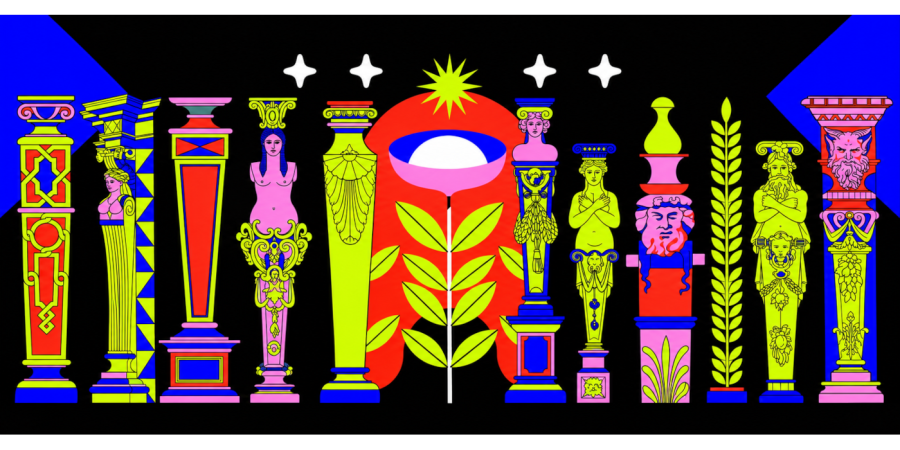
Image: Illustration by M\e.
Ashraf Johaardien is a South African writer\artist working across literary, dramatic and visual forms.
Ashraf Johaardien
ashrafjohaardien@me.com
M\e.
http://www.ashrafjohaardien.com
Disclaimer: Artslink.co.za encourages freedom of speech and the expression of diverse views. The views published do not necessarily represent the views of Artslink.co.za.