Art Fag Much?
Ashraf Johaardien: A brief meditation on the custodian and the keeper.
Sunday lunch.
The air-fryer hums, that low rush of hot air. Chicken and potatoes in there. Broccoli still going on the hob. While I wait I read the Tom of Finland Foundation “Community Update” twice.
Then we eat.
I still can’t name what unsettles me. It’s not the language. The language is careful, grateful, calm. The Board says the structure and location are changing but the mission is not. I read that sentence the way you check a fence post you suspect isn’t straight.
The Foundation holds a collection, a research library and, until now, an artist residency in a house in Los Angeles. The collection is moving to storage, the residency is pausing, and the Foundation can no longer operate at Mr Dehner’s home. Durk Dehner resigned as president in January 2025. The Foundation cited his use of offensive symbols and insensitive comments. Its 2026 statement does not mention why.
“Out” reported that the Foundation later said he had acted on his own, without its knowledge. Photographs of Dehner wearing Nazi symbols were reported by “Out” and “The Fight”. I have not independently verified the photographs. In a seven-slide open letter, former residents allege that nearly the entire staff was let go in June and the residency ended without notice. Those are their accounts.
My own link to this runs through a different archive. As a teenager in newly democratic South Africa, I found the gay world in “Exit”. Gavin Hayward’s name is on the masthead of issue 186, October 2005. He edited the paper from 1995 until a handover in June 2020. Its pages gave me bars and plays and small ads where men described themselves in a single line. I remember Tom of Finland’s illustrations there. I haven’t found the issue to prove it, so I hold it as memory.
What I remember is recognition. Tom Selleck as “Magnum, P.I.” Those short shorts. The floral shirt unbuttoned onto a chest that put a certain pressure on my diaphragm. My father had the exact same moustache, so I had never equated facial hair with queerness.
Now this other Tom.
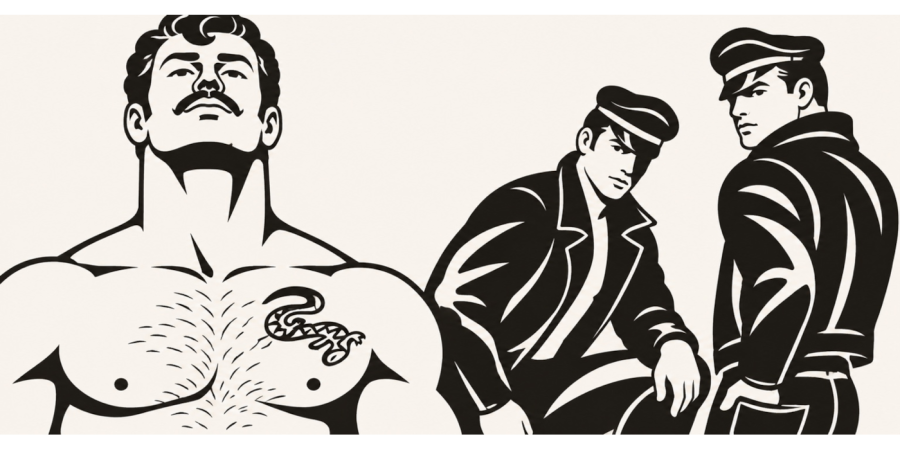
Exaggerated muscular bodies, uniforms, leather, boots, confident postures, explicit encounters and men with handlebar moustaches. Not the same pressure on the diaphragm. Recognition.
The moustache was familiar. Everything around it had changed. Here was masculinity in a visual language I had never encountered. Men looking at men. Men desiring men. Not as a joke or a diagnosis or a secret, but as the subject of the image itself.
I did not want to be one of those men. I recognised something in their world. The drawings gave male desire a form, a confidence, a visibility beyond my private imagination.
The men were magnificent, frankly. Broad shoulders, narrow waists, impressive equipment and an almost supernatural confidence that other men would be available. But that recognition was also a construction. The drawing had decided who got to be magnificent. It offered an erotic ideal, with its own standards of body and type, and its own exclusions.
Touko Laaksonen drew these figures for private circulation and later for print. They travelled further than the room they were made for. The physical works have owners. MoMA holds two drawings as gifts and credits the Foundation with copyright. The physical works and the copyright are held in different institutional hands. I can recognise myself in a drawing without owning the paper it was made on. I don’t own Tom’s men. I wouldn’t know what to do with them if I did. But I don’t think the institution holding the copyright gets to own every conversation about them either.
A cultural symbol can outgrow the institution that keeps it. Keeping the object is one responsibility. Keeping the relationships that give it meaning is another, and it is the harder one.
The Foundation decides where the objects are stored, who gets access and which version of the figure is shown. These are real responsibilities. Storage can protect a collection and still keep it visible. But what else moves with it? The residency was not simply a bed in a house with a significant collection. It put working artists in proximity to the work, its history and the questions it continues to provoke. An archive can be catalogued, climate-controlled and insured. A living culture has a habit of turning up with ideas, arguments and occasionally very inconvenient questions.
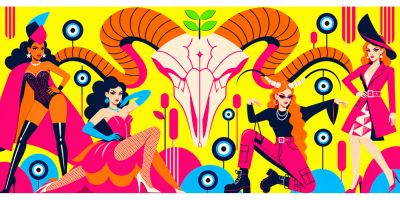
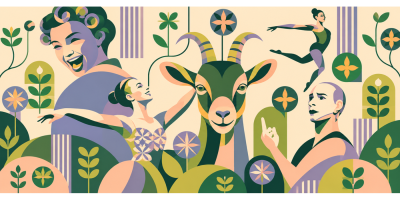
M\e. is naming its online group “Art Fag Much?” An art fag lives at the intersection of art, culture and provocation, treating desire, identity, labour and pleasure as material. An art fag asks what the body in the drawing wants, who it wants it from, and who was left out of the picture when it was made. There is a certain impatience with the idea that art should behave itself. Much? Because apparently we are still having to ask.
The Foundation is polite. It thanks its donors and apologises for the inconvenience. Politeness can become a governance style. It is not the same thing as care.
I don’t know what happened in that house. I do know that the institution has chosen to say very little, and that the people who worked inside it have said more. A keeper who explains less than the community asks is making a choice too.
I think the people who worked there, and the wider community that has sustained the symbol, have a claim to be heard on what happens to it. That is a claim about good governance rather than law.
Meaningful participation requires information. What is in the collection? Where is it going? What are the conditions of storage? What happened to the residency and the people who worked there? These are not unreasonable questions. An institution entrusted with a significant cultural archive should be able to answer them without behaving as though someone has asked to inspect the contents of its bedside drawer. Where they bear on those decisions, financial information belongs there too.
That is not the same as a right to decide what the uniform means. The uniform can be costume, fantasy, political image and historical object at once. Cultural meaning stays contested. The keeper’s task is to keep those readings open.
The keeper is not the only one with a key. Look at the drawing long enough and you will see who has been asked to stand outside it.
Ashraf Johaardien is a South African writer\artist working across literary, dramatic and visual forms.
Ashraf Johaardien
ashrafjohaardien@me.com
M\e.
http://www.ashrafjohaardien.com
Disclaimer: Artslink.co.za encourages freedom of speech and the expression of diverse views. The views published do not necessarily represent the views of Artslink.co.za.