
The Cutting Word
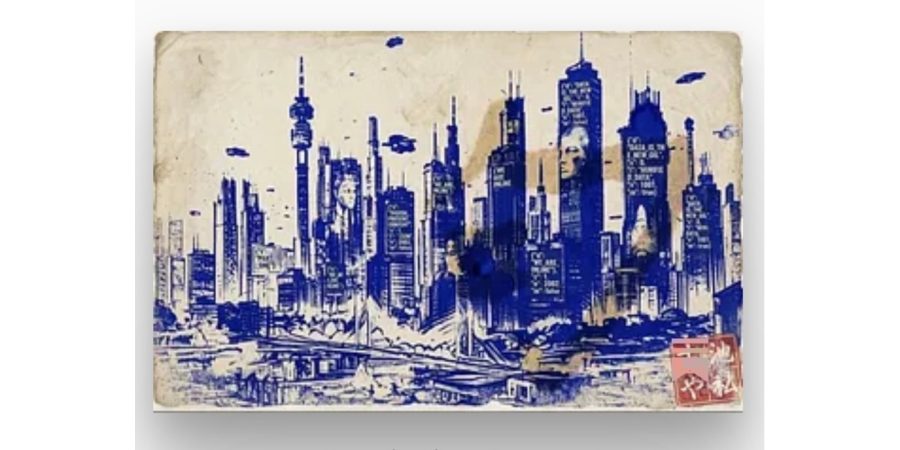
Ashraf Johaardien: A short meditation on a very short gap.
Mid-thought. I catch myself doing it again. A question I already know the answer to. My hand reaching for my phone before the recall has fully formed. The device unlocking before the thought.
I close the tab. Stay inside the gap. Outside, winter light flattens itself across the kitchen counter. Somewhere nearby a neighbour is sending long WhatsApp voice notes into the morning with the solemnity of a state address. My thumb still hovers over the screen like a reflex waiting for instruction. The answer comes eventually. Slower. Mine.
That interval is what I’ve been thinking about.
や is the kireji.
The cutting word in haiku. The place where the poem breaks and the break is the meaning. I’ve been trying to live inside that interval more intentionally.
Not artificial intelligence. Not the future of work. The small stretch of silence between uncertainty and remembering. The gap we’ve always taken for granted because nothing has ever collapsed it so completely before.
Something is happening to language and it isn’t what most people are arguing about. It’s happening at the level of the sentence. The small hesitations that used to mean a person was working something out rather than retrieving it.
You can feel it before you see the data. Pre-chewed. Soft like baby food for grown-ups who lost their teeth. Transitions that cost nothing. Cadence worn down into something that neither offends nor lingers. The written equivalent of a waiting room.
The real disruption isn’t knowledge. It’s what happens when instant retrieval replaces recall often enough that you stop trusting the slower process. Not because the machine is always correct. It isn’t. Large language models don’t know things in a human sense. They produce the most likely next word, then the next, then the next. But a fast answer lands in the body differently than a slow one. It forecloses something. You stop waiting for yourself.
A phrase from a recent article on AI governance stayed with me: generic tools deployed at scale. The argument was about banking systems. But the phrase got loose. Because we are also handing the same blunt instrument to millions of people and calling it thought. And to millions of artists and calling it process. The same pull toward the middle. The result isn’t stupidity. It’s sameness.
In a culture of creativity, sameness is slow death.
I want to be precise about what I mean here and I’m not sure I can be. There’s something that happens in the body when you can’t find a word. A specific quality of waiting. Not blankness. More like pressure behind the eyes, or the feeling just before a name surfaces. I used to live in that feeling. Now I’m increasingly intolerant of it. Ten seconds and the hand moves. I don’t know exactly when that changed. I’m also not sure it matters that I can’t pinpoint it, which might itself be the problem.
You can already hear the other thing creeping in. University newsletters. Brand strategy decks. Everything buffed to the same frequency. Nothing that snags on the way through.
Language has always been shaped by whoever controlled the dominant medium. Each one narrowed what sounded intelligent, what kind of voice got to be legible. AI is just the first medium that talks back, and it does so everywhere at once. So the narrowing is happening in the specific sentence you’re constructing right now, in the moment you decide it’s close enough and stop.
Generic language doesn’t feel generic while you’re producing it. It feels like clarity. But the writing that actually stays with people almost never arrived clean. It came in sideways, used a word nobody else would have reached for, survived on personality rather than correctness. The editing out of that friction is what produces competence. It’s also what produces forgettability.
The most interesting uses of AI I’ve seen come from people who walked in with something the machine couldn’t have started from. A writer I know uses it to collide with. She feeds it a half-formed paragraph and attacks the output, uses the wrongness as friction, builds against the resistance. The machine doesn’t write for her. It gives her something to push off.
Weak architecture gets absorbed. Strong architecture metabolises. I’ve repeated this to several people and watched them write it down, which makes me slightly suspicious of it. The idea is right but any formulation that detaches this cleanly from its context probably isn’t doing enough work on its own. What it means in practice is messier: you have to arrive at the machine already in an argument with yourself. A position that isn’t settled. An obsession it keeps trying to resolve and you keep refusing to let it. Something that makes the output feel wrong when it drifts, so you know when to pull it back.
Which is why I haven’t outsourced the sentence. Not because AI can’t produce prose. Clearly it can. But I don’t write only to communicate. I write to find out what I’m actually thinking, and I need the resistance of constructing the sentence to do that. When I skip that part I end up with something that sounds like me but arrived too easily. I can usually tell. I’m not always sure the reader can.
So I’ve reintroduced や deliberately. The pause when my hand moves toward the phone mid-thought. I wait. Thirty seconds. Sometimes a minute. Long enough for the slower process to arrive. It doesn’t always. Sometimes the machine still gets there first.
But I’m interested in what lives in that interval. The thoughts that come in a little rough, a little strange, still warm from whatever friction produced them.
Those are the ones worth waiting for.
The question isn’t whether to use the machine. It’s whether you can still recognise your own thinking when it arrives.
Ashraf Johaardien is a South African writer.
Read more of his work at Marginalia + Syntax.
Ashraf Johaardien
ashrafjohaardien@me.com
ME 古池や
https://ashrafjohaardien.substack.com/
Disclaimer: Artslink.co.za encourages freedom of speech and the expression of diverse views. The views published do not necessarily represent the views of Artslink.co.za.