
Schooled
Ashraf Johaardien: A brief meditation on who owns the classroom.
Birthdays.
Playdates.
School events.
That’s how Lesley and I know each other. Through our daughters, who are in the same class. There is a particular kind of adult friendship that develops around children. You exchange pleasantries at birthday parties, discuss school transport, occasionally discover you have more in common than the fact that your daughters are currently eating cake with their hands.
This year Lesley directed Provenance for the Fak’ugesi Festival. We rehearse at her house. At the start of one session I notice a pile of exam scripts she is moving out of the way. I have a weakness for an unattended document. Especially one that suggests somebody else has marking to do.
That is how this conversation begins.
My daughters attend private school. This was not initially the plan. We moved from the house we had lived in Melville for ten years to be closer to the public school in Northcliff. That was the plan. We even moved house for it. The plan, as it turned out, had not been consulted about the actual circumstances.
I went to Muslim Primary School in Wynberg. My mother was the vice principal of a school in our neighbourhood, but she had promised me that my teacher was an angel. So I went to school expecting one. Apparently I didn’t like what I found. My mother told me I asked to go to the bathroom and never went back. When they eventually found me at home, playing in the backyard, she asked why I had run away. I reminded her that she had promised me an angel, but my teacher was just a witch. True story.
Lesley Wright is a director and facilitator working across education, performance and collaborative development. A former drama teacher and Head of Dramatic Arts at Roedean School (SA), she spent twenty years teaching at some of Johannesburg’s top private schools. She now works part-time for a JSE-listed education group, mentoring teachers across school brands that have moved from one assessment system to another. Her work creates spaces for students, artists and audiences to interrogate ideas through live exchange, critical thinking and storytelling.
What happens when a teacher moves from a public school to one owned by a corporate group?
“Do you mean if the teacher moves from one type of school to the other, or if the school they work at transitions from government to private or corporate owned?”
I thought I was asking a question. Apparently I am also asking for a taxonomy.
Before the answer comes a caution about terminology. Sensible. It’s also the moment I realise that the word private might require more supervision than some of the children at the birthday parties.
Some schools are private but still use the DBE system, as Crawford schools once did. Many corporate schools were already privately and corporately owned before moving from the DBE to the IEB system. Private does not = IEB. Being an IEB school is one way of being an independent school, but it’s not the only way.
She lays out five distinctions: how a school is governed, who owns it, which curriculum it teaches, which examination it offers and which certificate the learner leaves with. None is interchangeable with another.
DBE and IEB schools both teach CAPS. Cambridge and IB schools do not. Both government school and IEB school matriculants receive the NSC.
Then she gives me the Crawford history in three lines:
Independent and private, early 1990s, under the DBE.
Corporate owned and private, late 1990s, still under the DBE.
Corporate owned and private, writing the IEB exam, from 2016.
Trinityhouse was a “single independent school (IEB)” and is now part of Advtech (IEB). Summit College is now Pinnacle College Kyalami, one of the mid-fee Pinnacle schools owned by Advtech (IEB).
She stops there. “… and dozens of other permutations!”
What actually changes at the front of the classroom?
“The basic content (curriculum) they are teaching is essentially the same; what changes is the way in which it is taught, and the style of assessment which follows the teaching.”
In other words, the content may be the same, but the way teachers approach it, and what learners are expected to do with what they’ve learnt, can be quite different.
In IEB schools, she says, there is more emphasis on critical thinking, analysis, the application of knowledge and the creation of original work. Then she reaches the edge of what she knows. “I’m not certain of the exact differences in planning and reporting; I’d be guessing here.”
I appreciate this. There is something reassuring about an education professional willing to say she doesn’t know.
What teachers notice first is sameness. She describes a demand for uniformity, with moderation forms, assessments and communication systems carrying the school branding, alongside tight financial control. Some of these schools provide very poor resources for teachers, especially in the Arts subjects. The freedom to push boundaries or innovate in the Arts is limited.
She is careful not to romanticise public education. Teachers in public schools do not necessarily have professional autonomy. Nor do teachers in independent schools outside a corporate group. It’s very much an individual situation, shaped by the size and character of the school, whether it is religiously affiliated, its age, management and general ethos.
Then ownership enters the classroom. Once a school belongs to a group, there is “more pressure on the school board, and thus on the school management, and thus on the teachers”. They need to make a profit, keep costs down and “make the school look good”.
Lesley is a theatre teacher. This is where the conversation becomes particularly interesting. In the Arts, theatre productions and art exhibitions are expected to be PR exercises. Serious, controversial or cutting-edge issues are avoided.
A school production as a marketing asset. The curtain goes up, the parents take photographs, the school gets its content. Somewhere backstage, a controversial idea is quietly asked to leave.
What do teachers gain?
“They would probably be paid better, and possibly enjoy better working conditions”, including more resources and support.
What do they lose?
They may lose creative and professional freedom or autonomy, and find themselves subject to rigid corporate systems: IT and communication platforms, and extensive paperwork and administration involved in purchasing books or paying guest speakers.
For parents, she has one observation. The public-versus-private choice, for those privileged enough to have it, is only the first layer in considering what kind of school they want their child to attend. There are many different kinds of private schools, and it’s worth looking more closely at the experience each offers.
For the young teacher, she has another. It is difficult to argue with:
“I know that realistically, young teachers are very often just happy to get a job anywhere, and for some, a school that is corporate-owned and will definitely pay your salary at the end of the month is enough.”
The pile of exam scripts is still in the room. I haven’t offered to mark them.
I began with a fairly straightforward question about what happens when teachers move from public schools to corporate-owned ones. I have ended up being schooled in the distinctions between ownership, governance, curriculum, assessment, certification, professional autonomy, resources, branding and the monthly salary.
A fairly comprehensive education, considering I only meant to ask one question.
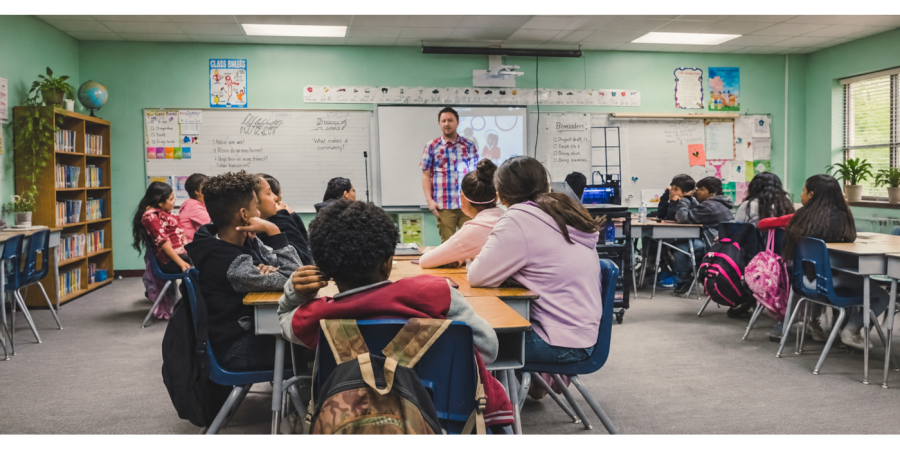
Image: Photograph by Kenny Eliason © 2017.
Ashraf Johaardien is a South African writer\artist working across literary, dramatic and visual forms.
Ashraf Johaardien
ashrafjohaardien@me.com
M\e.
http://www.ashrafjohaardien.com