In the Purple Rain
Ashraf Johaardien: A brief meditation on living in the world in times of trouble.
It is noon.
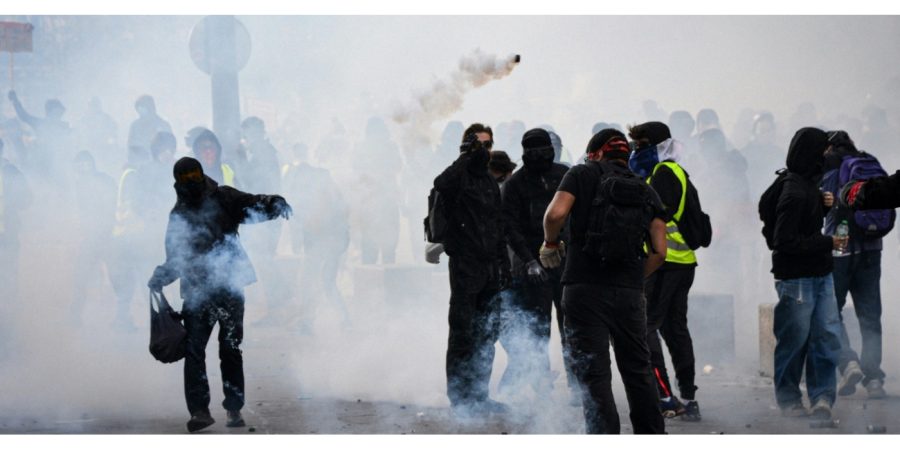
The standing fan oscillates, and its gentle, monotonous drone is making me slightly sleepy. I have drawn the blinds in the study to keep the heat at bay. I switch from the laptop to my phone. Images of the protests hijack my feed. Heavily armoured riot police in dark blue hold clear shields and push a crowd back.
In a New York Times photograph, officers advance through tear gas, faces hidden. A clip titled “Manifestation 31 octobre Paris” shows the same pressure from street level. The shields are the same shields. The crowd turns and scatters the same way.
Under the fan’s drone I hear engines, and they are not in Paris. They idle on the field across from the principal’s office, where the Casspirs park to watch the high school down the road. My thumb scrolls on, and the police are South African now: campus security and tactical units forming barricades against student marches. The phone shows them. The field shows them too. One slowly takes the place of the other.
The announcement sits on my phone beside the feed. According to Monopol, exhibitors at Art Basel Paris were told on Thursday 22 October that the fair would close at 7 p.m. the next day, two days before its scheduled end. The reason given was potential demonstrations that weekend, and threats of action at the Grand Palais itself. The fair decided, it said, “following discussions with galleries and relevant authorities, including the Paris Police Préfecture.” An Art Basel spokesperson told Monopol that it was the first time a fair of theirs had concluded early. Hannes Schmidt, showing for the first time with his Berlin gallery Schiefe Zähne, told Monopol he was not convinced. “I can’t see the threat. […] Nobody consulted us either. It just gets decided.”
Fifty-seven of the fair’s 211 exhibitors are members of the Comité Professionnel des Galeries d’Art. In a letter to the director, Karim Crippa, dated 28 October and reported by Artnet News and Monopol, the committee wrote of “profound incomprehension” among dealers, who read the lack of consultation as “disrespect, even contempt,” in Artnet’s translation. The committee accepted that closing on the Saturday was a matter of prudence, but asked “why Sunday?” Design Miami Paris, Offscreen and AKAA were open that day, as was the Cézanne et nous show inside the Grand Palais. The committee argued that smaller and mid-sized dealers depended on weekend visitors, and that the losses “call for fair compensation.” When I write requesting a copy of the letter, the committee’s project officer writes back and declines.
Le courrier était adressé directement à la direction d’Art Basel Paris et n’avait pas vocation à être rendu public ni à faire l’objet d’une communication auprès des médias.
On Friday 30 October police banned union and yellow-vest marches from the centre, confining them to a single route from Porte de Bagnolet to Porte de Charenton, and closed Place de la République and Les Halles to protest. For the weekend, 70,000 police and gendarmes were deployed. Unaccompanied minors faced a 9 p.m. curfew around the Champs-Élysées, though a court had earlier suspended a curfew on minors as an illegal infringement of freedom of movement.
The protests began with high school students angry about school conditions, then widened into anger over the cost of living. Authorities counted about 550,000 marchers on 17 October, when shops were looted, and 410,000 a week later, with more than 1,300 arrests.
Wynberg, 1981. I am six. At school we practise duck and cover for tear gas or shooting. One day we do it for real. My mother phones to say I am sick with nerves, and I stay home a week. The Casspirs park on the field across from the principal’s office, watching the school down the road. On the day they drive past our school in rows, we are dismissed before interval. They are big, like elephants made of machinery. Years later even a small picture of elephants makes my body shake.
It is 2 September 1989, four days before an election in which only white South Africans may vote. I am in Standard Seven, taking the train from Diep River to my father’s tailoring shop on Adderley Street. The train is packed, and students talk about a march on Parliament. At the station the street is a mass of people, so I take a back route. My father is waiting at the bottom of the stairs. He hurries me inside and bolts the door.
From upstairs we look down. Lines of armoured riot police face a crowd pressing forward, banners waving. A Casspir lurches forward and breaks the standoff. A violent hiss, and a high-pressure water cannon shoots a purple arc across the pavement. The crowd scatters as the jet hits the asphalt and splashes purple mist over fleeing figures.
The phone is still open in my hand. A riot officer lifts a shield in the clip, a gesture I have seen before, though not in this city or this decade. I am standing above Adderley Street again. The door is bolted. The lines below have not moved. For a moment the feed and the street are one light.
The image holds long enough to change. The purple arc from the clip becomes the arc I watched from the window, the window becomes the glass of the phone, and I cannot find the seam. The picture on the screen is no longer evidence of Paris. It is the one thing I still have of Adderley Street, and it has been there, at the bottom of the stairs, all along.
My father turns on the television. The SABC news opens as it always does: unrest in the city centre, police acting to restore order. The pictures arrive delayed and careful, a water-cannon truck, purple spray, people scattering. A voice-over reports arrests. Nothing is said about the journalists taken with them, or the people still being rounded up with dye on their clothes. The picture is grainy, the colours slightly off. He gives me biltong and says there is Coke in the fridge if I want it.
By late afternoon the main confrontation is over. The water cannon has stopped, and the shops that closed stay closed.
We drive home. My father is fair with straight hair; I look enough like him that the police at the roadblocks usually wave us through.
He keeps both hands on the wheel.
Photograph by Pierre-Louis Mièze, Paris, France, October 2026.
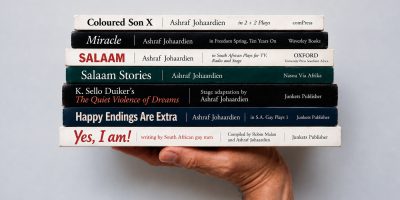
Ashraf Johaardien is a South African writer\artist working across literary, dramatic and visual forms.
Ashraf Johaardien
ashrafjohaardien@me.com
M\e.
http://www.ashrafjohaardien.com
Disclaimer: Artslink.co.za encourages freedom of speech and the expression of diverse views. The views published do not necessarily represent the views of Artslink.co.za.