Eyes Wide Listening
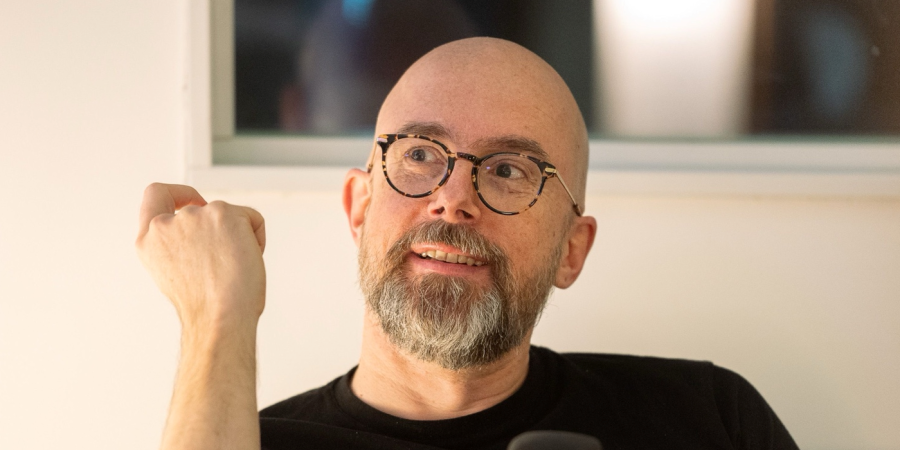
Ashraf Johaardien: Flow is music made with no picture in mind, and it asks the room to listen the same way.
Before his answers arrive I go looking for the clip of his Grammy acceptance speech. It is under a minute. Hans-Martin Buff is articulate, clear, unassuming. He thanks Peter Gabriel and Prince alongside his parents and grandparents, and there is no trace of name-dropping in any of it. Then something creeps into his voice.
“And most of all, I want to thank my wife, Patti, who’s gone on a date with me 30 years ago just before I went on a session. The date isn’t over and the session isn’t over either.”
Buff is a recording engineer and music producer who has worked with Prince and Scorpions. In 2025 he was honoured with the Grammy for Best Immersive Audio Album for his work on Peter Gabriel’s i/o, the In-Side Mix. On Thursday 15 October, 14:45 to 16:15, he brings Flow to the Wits Anglo American Digital Dome.
Flow was developed at Real World Studios in partnership with Dr Ruth Farrar of Bath Spa University, founder of the Immersive Audio Network, with Dr Felix Carter (University of Bristol) and Theo Kozlowski (University of Bath). The composition was written and recorded by Adrian Utley and produced by Hans-Martin Buff. Funded by UKRI’s Strength in Places programme MyWorld, with support from Digital Catapult.
Flow is a thirty-minute composition, according to its listing at SXSW London in June, made to be heard from every direction. The orchestra is guitars, voices, four double basses and electronic oscillators, with field recordings from Iceland.
The first thing he says in the speech is what the prize is for.
“this is a huge recognition for immersive music that isn’t a remake of something else but something special.”
He calls it a huge musical adventure, and thanks his fellow adventurers. Gabriel is “the biggest pirate I’ve ever met on the high seas.” Prince, his mentor, taught him how to fight for his adventure.
In my questions he reaches for a sunset to explain what a stereo mix cannot do.
“The difference between hearing music in stereo and listening to a proper 3D piece of music is like the difference between watching a sunset on TV and watching it unfold from a beach. You’ll never look back.”
I asked what taking away the visuals asks of an audience. He answers by correcting the premise.
“Flow isn’t built specifically for low light; it’s a piece of music that’s made without any visual consideration. It’s simply wonderful music.”
“The eyes unfortunately rule the brain’s judgement, so as soon as there’s something to see, the music takes on a different sense of reality. If you want to just play music, the eyes need a break.”
There is a textbook case for what the eyes do to the ears. In the ventriloquist effect a voice seems to come from the dummy’s mouth, because the mouth is what moves. Sight can pull a sound toward it.
In 2017, at Swiss Dance Days in Geneva, I lay on my back in a darkened theatre with the rest of the audience, shoulder to shoulder in a giant circle, watching a piece called MIRE reflected live in a mirror hung from the lighting grid. It was like staring into a kaleidoscope for forty minutes. The woman to my left fell asleep and started to snore. I was not sure at first how I felt about it. Every now and then the sound of a dancer’s feet or body landing on the stage put me back in my own body, and my own consciousness, in a way that was curious and quite delicious.
The mirror gave my eyes something to follow, and the thud of a body told the rest of me where I was. That is my reading of Geneva and I hold it loosely.
I would have called any lights-down room immersive: the theatre, the nightclub, the surround sound film, now the home entertainment system. The Grammy is perhaps a clue that Buff means a different kind.
Flow sits in the Imagination Engines on Thursday afternoon. The festival means the engines as frequencies, pitches a day is tuned to, and the Imagination Engines ask how a society generates what is possible. Buff’s answer, as I hear it, is that possibility may need less to look at. That is my reading, and he may take it elsewhere.
Placement, he says, is a question of story.
“The decision process is about what the music wants to say. If the story is huge, its telling will be huge. If it is small, I’ll pick a small corner.”
“Also, there are certain elements of human perception that help make placement decisions, for example a bird-like sound that wants to be above you, rather than in front of you.”
He puts the artist first. A great piece of three-dimensional music begins with all-around storytelling from the get-go, he says, and “the engineer simply executes artistic decisions.”
“If 3D music is merely an engineering exercise of turning stereo into something else, it’ll rarely be the ultimate artistic statement.”
Immersive audio gets sold on spectacle. Asked what it does best when it is quiet, he declines the spectacle altogether.
“I try to not do spectacle. Immersive music is great at all volumes. You’ll hear.”
Then the question aimed at African artists and studios starting out in spatial sound. What to learn first, and what to unlearn. His answer fits in five words.
“Don’t listen with your eyes.”
“The way the sound looks in a studio tool doesn’t matter, the audible impact does. It’s not about filling the room with gimmicks, it’s about telling YOUR story in the most amazing way possible.”
A studio screen shows sound as shape, and shape is persuasive. The ear is the only judge that counts.
The Wits Anglo American Digital Dome has ten projectors for 8K full dome pictures and an 8.2 audio system. It is a room built for pictures, and Flow was made without one in mind. On Thursday at 14:45 I expect my eyes to close.
Photo by Andreas Gladis.
Ashraf Johaardien is the Writer in Residence at the Fak’ugesi African Digital & Innovation Festival 2026.
Ashraf Johaardien
ashrafjohaardien@me.com
M\e. Creative
http://www.fakugesi.co.za
Disclaimer: Artslink.co.za encourages freedom of speech and the expression of diverse views. The views published do not necessarily represent the views of Artslink.co.za.