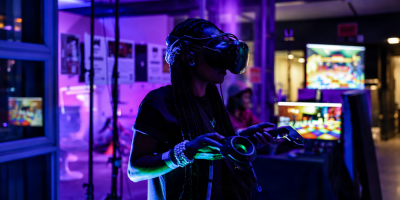
Artists Interrogate the Machine
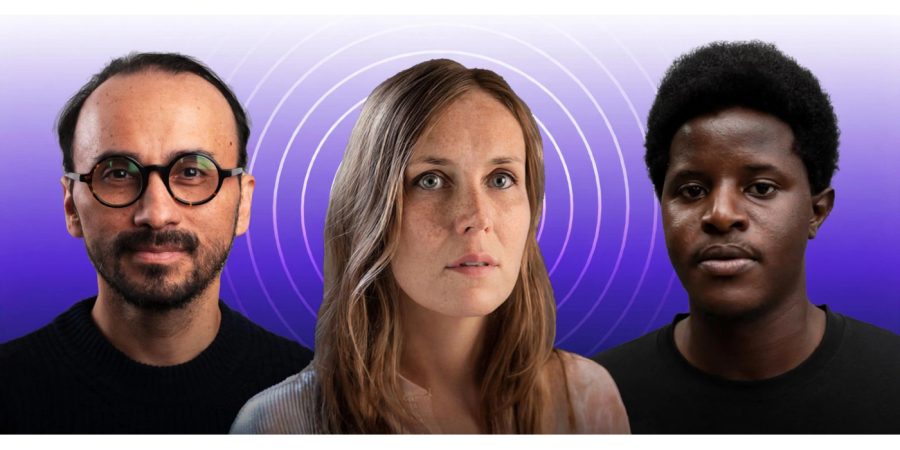
Ashraf Johaardien: Everyone talks about AI as if it’s one door. Three Fak’ugesi featured artists walk through it in three different directions.
AI has become good at making things. For artists, the more interesting question is what happens when the technology itself becomes part of the thing being investigated.
Fak’ugesi African Digital & Innovation Festival returns to Johannesburg from 13 to 17 October 2026 under the theme African Imaginaries, unfolding through Memory Engines, Imagination Engines and Future Engines.
Three positions in the festival make that question tangible. Evans Akanyijuka begins with the image. Akanyijuka is a Ugandan digital artist based in Kampala. His practice moves across photography, collage, photo manipulation and artificial intelligence – forms he uses as archive and inquiry into memory, heritage and identity. His bodies of work include Stillness (2024) and LoRA as an Archive, A Living Archive, developed through the ZaZi challenge within the S+T+ARTS Afropean Intelligence Residency with Market Photo Workshop.
At Fak’ugesi, Akanyijuka presents “AI and Photography” from 13 October (09:00-17:00) at the Tshimologong Digital Innovation Precinct. The work interrogates a specific and urgent question: who gets to image Africa? AI-assisted photography sits at a precise intersection of authorship, visibility and archive – the decisions about which images become training data, which visual languages are recognized as legitimate, which stories get told through which formal strategies. Generative systems draw on vast visual repositories while obscuring the assumptions embedded inside them. In Akanyijuka’s practice, photography has never been neutral – it decides what becomes visible, what remains legible, whose face belongs in the frame.
Generative systems compound that truth by adding another layer of decision-making, another set of inherited biases, another apparatus of control and exclusion. Yet they also open new possibilities for expression and articulation. Akanyijuka puts it like this: “I found I could say things with creativity and through manipulating photos that I had no words for.” The work is presented with the support of the Institut français through Appui aux Opérateurs Culturels en Afrique.
Renzo Filinich Orozco turns the question around. Filinich Orozco is a Chilean media artist and researcher, the festival’s featured artist, and postdoctoral researcher at the Origins Centre and the Machine Intelligence & Neural Discovery Institute at Wits. Between 09:00 and 17:00 daily from 14 to 16 October at the Tshimologong Digital Innovation Precinct, he holds two works as a continuous presence, reinterpreting archival images and exploring human-machine co-creation.
“Quantum Echoes of Humanity” is an interactive audiovisual work that uses AI, facial recognition and recursive algorithms to reinterpret anthropological archives from the Origins Centre. Archival images are set in motion as constantly evolving visual and sonic forms, questioning colonial systems of representation and inviting more fluid relationships between humans, machines and the non-human. The work refuses the archive as fixed or stable; instead, it treats archival images as generative material, constantly re-performed through the interventions of machine perception and human attention.
“Echoes of the Machine – A Cybernetic Song” (2025–2026) sits alongside it as an interactive installation of artificial neurons, light, sound and audience participation. Taking South African birdsong as its teacher, it explores co-creation through listening, imitation, feedback and uncertainty. Filinich Orozco positions technology not as a tool for control or command, but as a relational environment where human and non-human intelligence meet. The installation invites visitors to listen to what machines might perceive, to inhabit a different kind of sensory world.
Dagmar Schürrer brings the question back to the body. Schürrer is an Austrian artist based in Berlin, working across expanded animation and XR. Her practice sits at the intersection of science, emerging technologies and human perception – biology, neuroscience, AI and digital world-building, held together by a poetic attention to consciousness. She approaches AI through expanded animation, XR and fundamental questions about what technology reveals about perception itself.
On 15 October from 12:45 to 13:30 at the Chris Seabrooke Music Hall, Schürrer presents “Same Prompt, Different Planet” – a live exploration of expanded animation, XR and AI reshaping perception. The title poses a central problem: what happens when the prompt stays the same but the person, history and perspective entering the system change? The work considers how AI systems respond differently depending on who is prompting them, how cultural context and embodied knowledge reshape outcomes, and what becomes visible or hidden in that exchange. Built around SYNTHIA, a hybrid avatar modelled on the world’s first computer-designed bacterium, the work moves between monitor, headset and life-size 3D-printed form, moving the digital into material space and vice versa. Presented in partnership with the Austrian Cultural Forum and Austrian Embassy.
Schürrer’s presentation opens a conversation about authorship, agency and the invisible assumptions built into systems we treat as objective tools.
The question sharpens across three practices. Akanyijuka traces the image back to its sources: the training data that authorized it, the archives that made it legible, the authorial decisions encoded in the algorithm’s response. What it means for an African artist to work in a generative system trained on the world’s photographs – to ask who decided which visual languages count as real. Filinich Orozco listens to what the machine hears, what it perceives when you strip away human sensory priorities. The archive moves. Non-human attention activates it differently. Schürrer watches the same prompt yield different outputs depending on who enters the system, what histories and embodied knowledge they carry with them.
The prompt stays constant.
Everything else shifts.
None of this constitutes failure.
It constitutes evidence: of how technology encodes power, of how neutrality is always a story, of how the machine’s logic reveals our own unexamined assumptions about the world.
Ashraf Johaardien is the Resident Writer at the Fak’ugesi African Digital & Innovation Festival.
Ashraf Johaardien
ashrafjohaardien@me.com
M\e. Creative
http://www.fakugesi.co.za
Disclaimer: Artslink.co.za encourages freedom of speech and the expression of diverse views. The views published do not necessarily represent the views of Artslink.co.za.