Me Against the Music
Ashraf Johaardien: M\e. is a practice. It can arrive somewhere without me.
It’s me against the music It’s just me And me
There it is.
I can barely see the lake. The jacarandas hang low and dense and hide it from the bedroom balcony. Birds are calling off the water; I can’t tell which voice belongs to which bird. My daughter is at the hallway mirror. The school run is minutes away.
I stand over a pile of boxer shorts looking for a pair that still fits. Winter has been long. Next to the phone, the clothes for the day lie on the bed in the rough shape of the body that will wear them.
The phone sounds. An invitation. The mark is in it, and when I click through, the site carries the same mark. I dress quickly, drop the phone into my bag on silent, and go.
Hours later I am in the Checkers in Emmerentia with dinner supplies. The line is longer than expected. The light is fluorescent, more warehouse than supermarket. A phone has a quiet power over waiting: it erases it. One voice in my head says nobody can hear you scream in space. Another asks whether in terror or in delight. Both, the first answers.
Main Partners. A row of marks scrolling, one tier among several. One is a white speech bubble with M\e. in blue. Beside it, at the moment of looking, sit the Machine Intelligence and Neural Discovery Institute (MIND) and the Ambassade de France.
I have no need to open the programme. I already know it.
Anyone scrolling on a phone meets the mark there. They do not know the conversations, the versions with the frog, the one where the backslash went missing. They see a logo among partners and move on.
The work is already performing.
I am not in the room.
A performance needs the performer present. A practice does not. The scales played every morning are not the concert. They are what make the concert possible, and they continue after the hall is empty.
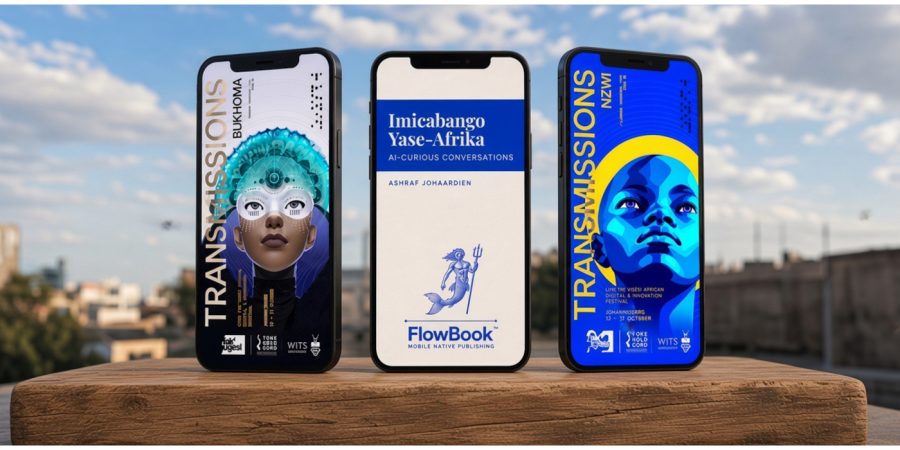
At the foot of each column I write for Artslink, two words sit where an employer’s name would usually go: M\e. Creative. The essays are mine. Transmissions, the mobile publication made for a festival, ends with a colophon: Developed, compiled and edited by M\e. Designed by the festival’s in-house designer. My name is not in that sentence. It does not need to be.
What sits under the visible is rarely seen. Jensen Huang told Caltech’s class of 2024 why his company built before anyone knew how far it would go: “Our logic is: If we don’t build it, they can’t come.” The people who use what came of it meet only the use. The use looks like weather. The maker is nowhere in it.
A brand wants one mark and polices it. M\e. answers to several. The bubble. A circle with a face folding into it. An outlined ligature that drops the backslash. A frog taken from Bashō’s old pond. What holds is the grammar: a cut that keeps two things present at once. The rest changes with the room. This room got the bubble, sized by someone else and placed among institutions.
Because it issues invoices, people sometimes take it for consultancy. A consultant hands over recommendations and leaves. What comes back from M\e. is usually a document you can scroll on a phone, and sometimes a person who begins to argue their own case differently. The thesis returns clearer. The website returns with an institution able to say what it does.
M\e. starts by looking for what is actually carrying the weight. Every structure is carried. The method asks what holds a publication up, what only appears to, and what has become decoration. Atlas first, then Purpose, Strategy, Action. FlowBook, the form Transmissions is built in, applies the same question to the phone, where the unit is the scroll, not the page. Ask M\e. puts the question to people, a stranger at a samoosa stand, an uncle at a braai. Most conversations end not in an answer but in a better question. The question does the real work.
M\e. has had other names. aj&co. endymion. iMAGO. Each pointed back at a person: initials with an ampersand, a sleeper from myth, the last stage of an insect. M\e. is the first that cuts. Upper-case M, backslash, lower-case e, full stop. Read it fast and it says me. Read it slowly and there is a line through the middle of the word.
Writer/artist offers a choice. Pick a lane. Writer\artist leans the other way. The backslash does not so much divide two identities as cut between them, the way the particle や cuts Bashō’s old pond before the frog jumps. Something stops. Something else becomes audible.
The backslash sits at an angle to the light.
Some of it goes through.
Some of it comes back.
A logo on a partner page can be administration. It can be proof. I cannot tell from here. The mark is small enough to miss and specific enough that, when someone does notice it, they ask one question.
The test is the partner page. Virgil Abloh said everything he did was “for the 17-year-old version of myself,” a reader not in the room. The person scrolling past on their phone is that reader. They pass the bubble among the other marks and do not stop. They do not read this either. They go on to the programme. The line moves. I put the phone away.
The scales continue after the hall is empty.
There it is.
M\e. is an editorial practice specialising in mobile-native publishing built on standards such as FlowBook™, and in campaign copywriting through the line, for digital and print media.
Ashraf Johaardien
ashrafjohaardien@me.com
M\e.
https://me-editorial.crd.co/
Disclaimer: Artslink.co.za encourages freedom of speech and the expression of diverse views. The views published do not necessarily represent the views of Artslink.co.za.