Rebel Angel Upstart
Ashraf Johaardien: A brief meditation on how publication secures an author’s record, obscures it or replaces it, and why permission is not a courtesy.
Gratitude is a verb.
I begin my list before the sun reaches the desk. I give thanks for the labour of people who worked in rooms that have since been repurposed. This morning I went through the study one object at a time, photographing what I cannot yet file. I work with the phone held flat over paper that curls at the corners.
Among the papers is a catalogue from Junkets Publisher in Mowbray, Cape Town. It lists Robin Malan’s numbered playscript series, with authors and titles. “iHamlet” is in it. I have found no online copy of the script. The catalogue records that the work existed, under whose name and in which series. It does not establish who holds the rights today.
Robin’s biography of Keats for young readers, “Rebel Angel,” takes its title from a letter Keats wrote to Benjamin Haydon in May 1817. “I feel confident I should have been a rebel Angel had the opportunity been mine.” The sentence is conditional. It does not say what opportunity he lacked. It offers an image of defiance from outside the room.
In my experience, a writer who insists on being asked is in that position. In a sector that treats permission as a courtesy, the request can read as presumption, and the writer who makes it is cast as the upstart. The presumption belongs to the person who proceeds without asking. The case below is one I know from the inside.
At lunch on 18 February 2022, I began an email to a former lecturer. I was sitting on the dance mat in the studio at Moving Into Dance. The air conditioning was not working, but the wall of glass fully opened onto the street was keeping us from dying. My reflection in the mirror did not help. I sent it at 22:58, back on wifi. The email asked him to meet a dancer I had met at Swiss Dance Days and my dramaturg. It attached a draft of a play called “Karaoke for the End of the World.” Rachel was born when he choreographed me as a student in “Wet and Other Works” in 1994. I wanted him to meet her again. He met my collaborators, but not Rachel. Four years and eight months later, he has not replied to me. The request is in my sent folder, dated and timed. I have had no answer.
Robin’s series put playscripts into a catalogue that outlives the people who wrote them. Publication can secure a record, and it can also work the other way. A book printed without the author’s approval of the manuscript does not simply fail to credit its author. It replaces the version the author approved, and the replacement is what circulates.
Robin adapted Shakespeare’s “Hamlet” as a solo work for me, and I performed it in 2012. His compilation of the full play gave Hamlet all the speaking parts, with the action adapted for a single performer. The work was published as “iHamlet” and “Lord Hamlet”. A production called “I Lord Hamlet” is listed on the Woordfees programme for October 2027. The programme says it draws on Robin’s compilation and relocates the gravedigger scene to the contemporary Cape Flats. Robin died in September 2024.
Neither his death nor Shakespeare’s public domain status settles the rights in Robin’s adaptation. I do not know who holds those rights today. The obligation is to establish provenance before staging, not to reconstruct it afterwards.
Nasou Via Afrika published an ensemble version of “Salaam Stories” without a signed contract or my approval of the final manuscript. When my agent at the time raised the issue, the book was withdrawn from the market. I have been told that copies could still be ordered online, and I have a scan made with a friend’s permission. Withdrawal determines what the publisher sells. Whether a binding agreement existed is for a lawyer to establish. What I can establish is the sequence: publication, objection, withdrawal, and copies that outlast both.
“Salaam Stories” shows a wider problem. A text can survive as an object while losing the record of how it came to be. What survives is not necessarily a reliable account of the work.
My play “Happy Endings Are Extra,” written in 2003, had its Orange County premiere with Theatre Out in Santa Ana, California, and was reviewed by the “Orange County Register” in October 2009. Permission had been granted. According to my account, the licensing fee and royalty were never paid, and my follow-up attempts went unanswered. An authorised production can still leave the author unpaid.
DALRO has referred applications to license performances of my work to me several times. I have generally said yes, waiving fees in some cases, particularly for schools. The licensing process is not the problem. A waiver is a choice. The distinction is between a fee an author chooses to waive and a fee or permission that someone else treats as irrelevant. One is generosity. The other is assumption.
The responsibility falls on the institutions that publish, license and stage work. They are the ones best placed to keep a work’s history attached to it. Most productions need someone to ask early, keep records that outlast the run, and sign before the first performance.
The catalogue is still open on the desk, its pages curling at the corners. It kept the title and the series number. The printed copies of “Salaam Stories” keep a version I did not approve.
Neither keeps the room where the work was made.
Nor the people who made it.
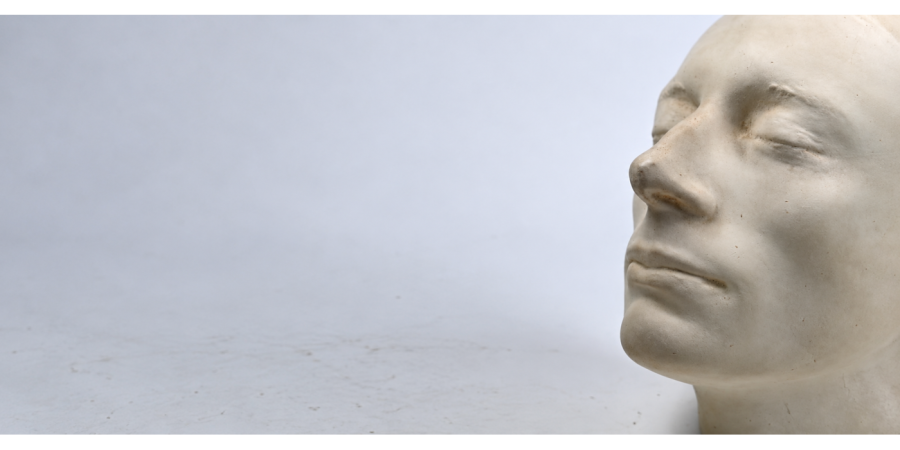
Image: Life mask, by repute of John Keats, plaster cast. Courtesy Andrew Smith & Son, Winchester, 2022.
Ashraf Johaardien is a South African writer\artist working across literary, dramatic and visual forms.
Ashraf Johaardien
ashrafjohaardien@me.com
M\e.
http://www.ashrafjohaardien.com
Disclaimer: Artslink.co.za encourages freedom of speech and the expression of diverse views. The views published do not necessarily represent the views of Artslink.co.za.