Interrogating Artiface [sic]
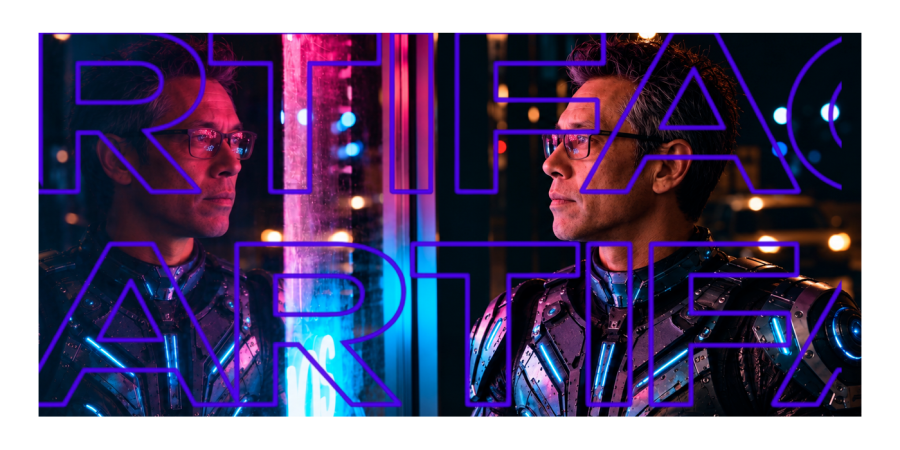
Ashraf Johaardien: A brief meditation on the battle between AI and provenance, what holds, what refuses to move and who keeps the kill list while the bodies pile up.
A [sic] usually tells the reader that an apparent error belongs to the source, not the writer. It marks the discrepancy and lets the sentence proceed.
Artiface [sic] keeps the mark and changes its job. The misspelling is chosen, and the bracketed note claims it. Art, artifact, artifice and face sit in one word without settling.
That ambiguity is useful because the AI debate has become a way of avoiding harder questions. Whether a machine can make art is the question people reach for first, and it lets everyone skip the others: who appears to have made something, who decided, and what the face on a cover is doing there. A magazine face is chosen, lit, styled, repeated and attributed. Those choices did the work of authorship long before AI arrived. AI only makes them harder to overlook.
Alec Slade is where I want to start, because he is the same figure across two forms. In Provenance he is a comedian in his fifties who begins in a stand-up frame and asks where his material comes from, what happens when it is copied, and what stays yours once it circulates. He performs everyone except himself, so the question of who speaks is part of the act. Alec is a human-authored fictional character, not an AI character and not a separate avatar. The continuity is the point. He does not change because he has moved into a magazine. The magazine asks what a character becomes when his material is reshaped by a new interface.
In ARTIFACE [sic] he becomes a cover presence and a host-like framing device. His visual register grows theatrical: sequins, boilersuits, matador trousers, lifts, mirror boxes, porcelain bulls, black-rimmed spectacles, and often one sneaker with one bare foot. He stays composed whatever surrounds him. Each cover is an act of selection and repetition, and repetition is how a face becomes recognisable. What I keep returning to is whether recognisability can be trusted when the conditions of an image’s production are not legible in the image itself, and the character has no existence against which to check it.
Provenance then turns practical. When material is copied, recombined and transformed, what separates appropriation from development? The answer rarely sits in the object. It sits in the record. I have described provenance as the chain of custody, meaning who held this story, who signed it, who gets to claim it. Since 2 August 2026, Article 50 of the EU AI Act has required providers of generative AI systems to mark their outputs in a machine-readable form, subject to transitional provisions and exceptions. The FlowBook edition of five conversations, published in October 2026, pushes the same question outward. Benjamin Rosman, asked about the provenance of leading AI systems, locates the problem in power. Provenance is about understanding whose knowledge became infrastructure, whose assumptions became defaults, whose labour became hidden, and whose worlds are missing altogether. Sennay Ghebreab asks for a move from extraction to recognition, and from exploitation to shared ownership. The Western AI debate is not global. Questions of whose values shape AI, and whose knowledge becomes infrastructure, look different from other parts of the world.
Attention is the other infrastructure. A carousel of portrait slides, read with a thumb between other things, is a different publication from a printed issue or a stage. Sequence, recurrence and interface decide what is noticed, and those decisions are editorial even when they are automated. Tammy Hodgskiss Reynard makes the museum version of this plain: what goes on display and what stays in storage determines which memories survive or acquire value. ARTIFACE’s teaser carousels work through a related logic. Each tile repeats a fragment in a colour that shifts row by row, until the fragment becomes what is watched. Hans-Martin Buff, a recording engineer who works in three dimensions, observes that the eyes unfortunately rule the brain’s judgement. A post can reach far and still vanish. A catalogue on a shelf can outlast the platform that announced it.
The work’s first public development reading took place at a local digital and innovation festival in Johannesburg, on 15 October. The room included a representative of a medical consultancy working with AI, a cinematographer from Berlin, a recent UCT graduate, a parent who had left the school pickup, and a facilitator presenting on arts funding and AI. My residency question had been simple: can a machine be funny? My answer is that in controlled settings, it already is. The harder question is what kind of funny, under what conditions, and who gets the credit or the blame. The encounter shows that the question of how a fictional comedian should be staged for an audience already contained the question of authorship. It does not show what any audience concluded, and I won’t supply a conclusion for it.
ARTIFACE [sic] is a designed publication working inside the attention economy it examines. Its deliberate error does not confer originality, ethical authority or independence from platform systems. Its section names, It’s A Vibe, That’s Hot, First Draft, Nut Graf and AI Awful, prepare the reader before the reader has read anything. The dateline gives coordinates and withholds the place. The split-A works as signature and logo at once. Each device is sharp, and recognition is the currency it interrogates. Alec’s continuity works likewise. A cover that repeats its figure is consistent, and consistency is also a form of control.
The FlowBook edition puts its authorship in a single line. The questions were mine, and the answers remain theirs. ARTIFACE has no such line yet, and its mark does not supply one. What is authorship when the face is constructed, the error curated and attention the product? The [sic] does not settle it. Alec stays composed, the brackets stay around the mark, and the final letter is still withheld.
The question is whether a work can remain accountable for its origins when the systems that carry it are opaque.
And who gets to appear on the cover.
Ashraf Johaardien is a South African writer\artist working across literary, dramatic and visual forms.
Ashraf Johaardien
ashrafjohaardien@me.com
M\e.
http://www.ashrafjohaardien.com
Disclaimer: Artslink.co.za encourages freedom of speech and the expression of diverse views. The views published do not necessarily represent the views of Artslink.co.za.