
Nightsong: where ancestral voices come alive
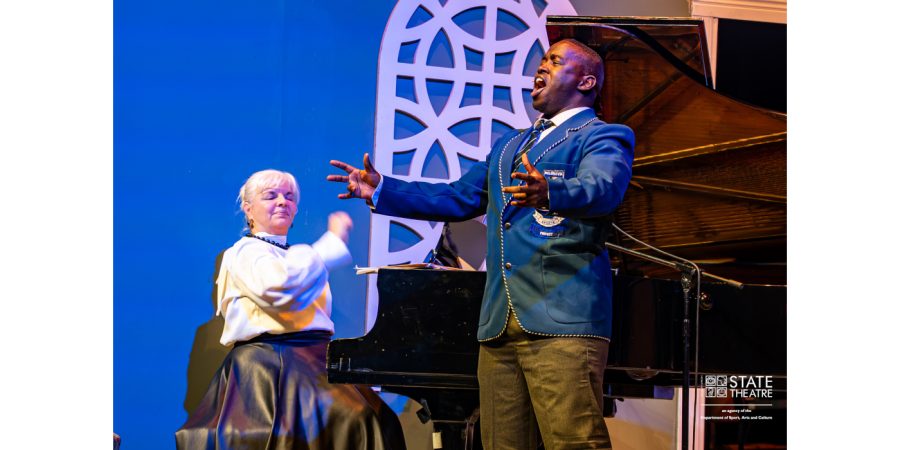
Bongani Nicholas Ngomane: A young man’s search for his father becomes a moving celebration of isicathamiya, cultural identity and the extraordinary power of music at SAST.
NIGHTSONG: WHEN THE VOICES OF OUR ANCESTORS MEET THE KEYS OF A PIANO
An extraordinary celebration of isicathamiya, identity, memory and the music that refuses to be forgotten.
What happens when a young Black man, searching for the father he never knew, discovers that the answers to his identity are hidden in the harmonies of isicathamiya? What happens when the gentle footsteps of hostel singers encounter the sophisticated keys of a European classical piano? And, perhaps more importantly, who gets to decide which music is worthy of being called art?
These are some of the compelling questions explored in Ingoma-busuku / Nightsong, a musical production directed by Themba Mkhize and Aubrey Sekhabi, which officially opened at the South African State Theatre’s Drama Theatre on Wednesday, 21 October 2026.
Before the first dramatic exchange, the audience was already being welcomed into a world of extraordinary musical beauty. The gentle, carefully harmonised voices of isicathamiya singers filled the theatre, establishing an atmosphere that was simultaneously nostalgic, spiritual and celebratory.
With the Drama Theatre almost filled to capacity, the opening night was more than a theatrical presentation. It became a gathering of memory, culture and generations.
A young man’s search for his father becomes a nation’s conversation with its musical heritage.
At the centre of the story is Jabulani, affectionately known as Jabu, played by the vocally gifted Mthobisi Khanyile. Jabu is a young man determined to understand the father he never knew. However, his journey is not simply about discovering a name or tracing a family history. It becomes an exploration of belonging, masculinity, cultural inheritance and the musical traditions that shaped the lives of Black South Africans.
His father, known as Stitch, belonged to the world of hostel life and isicathamiya. To understand him, Jabu must learn the music he sang, the movements he performed, the communities he belonged to and the circumstances that shaped his identity.
The production beautifully demonstrates that music is not merely entertainment. It is an archive of lived experiences, a repository of memories and a language through which generations communicate.
In one of the production’s most engaging sequences, Jabu encounters the world of hostel singers, where men gather on benches, play dice, share drinks and express their collective experiences through song.
The performers’ white shoes, carefully coordinated movements and gentle harmonies evoke the distinctive aesthetic of isicathamiya. Their voices rise and fall with remarkable discipline, reminding the audience that this musical tradition demands not only vocal talent but extraordinary listening, bodily awareness and ensemble precision.
The audience responded with ululations and applause, turning the theatre into a space of collective cultural recognition.
When the hostel meets the suburbs
One of the production’s strongest achievements lies in its visual storytelling.
Set designer Sherldon Marema creates an impressive theatrical environment that places contrasting social worlds in conversation. The suburban home, complete with couches, windows, a bed and a piano, stands in contrast to the hostel environment associated with Jabu’s father’s history.
The set is not simply decorative. It becomes a visual metaphor for South Africa’s social divisions, particularly the historical separation between domestic workers and their employers, township communities and suburban privilege, and African cultural practices and European artistic traditions.
The projections further expand the production’s visual language. Images of informal settlements, commonly known as imikhukhu, and other urban environments transform the backdrop into a living representation of South Africa’s social landscape.
The visual design effectively reminds audiences that the story extends beyond the physical boundaries of the stage.
Lighting designer Pretty Masemola deserves particular recognition for the intelligent use of lighting to establish time, mood and dramatic transitions. The lighting does not merely illuminate the performers; it participates in the storytelling, shifting the atmosphere between intimacy, memory, discovery and celebration.
Together, the set, lighting and projections create a visually compelling theatrical experience.
The women who carry the stories
While Jabu’s search drives the narrative, the women in Nightsong provide some of its most significant emotional and ideological moments.
Sikelelwa Zuma portrays Nomasonto, Jabu’s mother, a domestic worker whose relationship with her employer, Mrs Smith, reveals the complex social dynamics of race, class and cultural identity.
Rostislava Pashkevitch-Ngobeni plays Mrs Smith, whose connection to European classical music initially appears distant from the world of isicathamiya.
Their exchanges are particularly revealing.
In one moment, Mrs Smith speaks dismissively about isicathamiya, prompting Nomasonto to challenge her attitude. It is a small but powerful theatrical intervention.
Nomasonto refuses to allow African music to be treated as inferior simply because it does not conform to European classical traditions.
This moment raises an important question: Why have African musical traditions so often been expected to justify their artistic value against Western standards?
The production does not resolve this question through lengthy political speeches. Instead, it allows music, performance and human relationships to carry the argument.
Another memorable moment comes through the appearance of the Zionist church women, dressed in their distinctive uniforms, whose spirited singing and physical expression introduce a powerful spiritual dimension to the performance.
Their presence reminds us that music in African communities is deeply connected to worship, healing, collective identity and ancestral memory.
Uncle Muzi: laughter, secrets and the truth that alcohol cannot hide
Sabelo Sekgoto’s portrayal of Uncle Muzi brings an entertaining and refreshing dramatic energy to the production.
The character’s drunken behaviour, comic timing and tendency to reveal family secrets generate considerable laughter from the audience.
However, beneath the humour lies an important dramatic function.
Uncle Muzi becomes one of the figures through whom hidden histories are exposed. His comic interventions offer relief while advancing Jabu’s search for the truth.
Sekgoto’s performance demonstrates how humour can serve as a vehicle for difficult conversations about family, identity and the past.
When isicathamiya meets classical music, something remarkable happens
Perhaps the production’s most exciting artistic achievement is its exploration of the relationship between African vocal traditions and European classical music.
As Jabu begins to understand isicathamiya, he discovers musical connections between the traditions that initially appear to occupy different cultural worlds.
Under the guidance of Mrs Smith, the young singer explores vocal technique, musical structure and the possibilities of combining the two forms.
Their musical exchanges become especially captivating when Jabu sings while Mrs Smith accompanies him on the piano.
Khanyile’s vocal performance is impressive. His breath control, expressive phrasing and ability to move between different musical styles reveal a performer with considerable musical sensitivity.
The audience repeatedly applauded his singing, particularly during the operatic passages and the softer, emotionally resonant performances of imbube.
In another delightful moment, Jabu invites the isicathamiya singers into Mrs Smith’s musical environment, where they experiment with staccato phrasing and call-and-response structures.
The encounter demonstrates that musical traditions do not have to compete for legitimacy. They can engage, influence and enrich one another without necessarily surrendering their distinct identities.
This is where Nightsong becomes particularly meaningful.
The production invites audiences to reconsider the hierarchy that has historically positioned European classical music as sophisticated and African indigenous music as merely traditional.
Through Jabu’s musical experimentation, the stage becomes a meeting place for different systems of knowledge.
Isicathamiya as a living archive of South African history
One of the production’s greatest strengths is its educational value.
Rather than presenting isicathamiya as a musical genre detached from its history, Nightsong explores its relationship with migrant labour, hostel culture, urbanisation and the social lives of Black South Africans.
The production recalls the significance of spaces such as the YMCA, where workers gathered after long days, exchanged stories, socialised and participated in musical activities that kept their cultural identities alive.
It is within this social history that the story of Jabu’s parents acquires deeper meaning.
The revelation that Nomasonto and Stitch met in this environment connects the young man’s personal search to a wider history of movement, labour, love and survival.
Even Stitch’s nickname becomes part of this cultural memory, recalling the distinctive white stitching associated with the shoes worn by performers.
The production also acknowledges the musical legacy of groups such as Ladysmith Black Mambazo and the King Star Brothers, recognising the artists who helped shape and popularise isicathamiya.
The appearance of the Mtuba Thulisa singers adds further authenticity and excitement to the performance. Their harmonies, stage presence and musical discipline celebrate the continuing vitality of the genre.
Their contribution reminds us that isicathamiya is not a forgotten musical tradition preserved only in historical recordings.
Bongani Nicholas Ngomane
nicholas.ngomane87@gmail.com
072 700 6030
SA Theatres Reviews
http://www.satheatrereview.co.za
Disclaimer: Artslink.co.za encourages freedom of speech and the expression of diverse views. The views published do not necessarily represent the views of Artslink.co.za.
Disclosure: Bongani Nicholas Ngomane serves as a Dramaturge and PR & Communications professional at the South African State Theatre. This review reflects his personal critical observations of the production.