The future under construction
Ashraf Johaardien: Imagination, Infrastructure and Future Engines at Fak’ugesi 2026.
What happens when AI can give you an answer, but the more important work is deciding whether it is the right question to ask?
Imagination changes the question before innovation changes the future.
That sits underneath Future Engines at Fak’ugesi 2026. The programme treats the future as something made, and technology as a material with politics. Its proposition is that something changes when different forms of knowledge, experience and practice are brought into relation.
Imagination, in this context, is not fantasy. It is one of the ways the future gets built. Future Engines takes place on Friday 16 October, during Fak’ugesi (13 to 17 October), when the programme turns towards the systems through which futures become operational. Infrastructure, here, means whatever determines what can connect, what can persist and what stays invisible. A road determines who can move through a city. A language shapes what can be expressed. An archive determines what remains retrievable.
“Beads as Bytes” makes the point before the computer enters the story. Tanushka Ramdin / T A N Z reframes Ndebele and Zulu beadwork as a form of encryption: long before code meant software, beadwork was already carrying code. Intelligence has never belonged exclusively to machines or digital systems. What forms of intelligence have we failed to recognise because the structures used to define knowledge were built to see something else?
On Thursday 15 October, Dr Benjamin Rosman opens the Imagination Engines with the keynote “The Intelligence Century | Why Africa Must Help Invent It”. Rosman is Founding Director of the MIND Institute at Wits and Chief Scientist at Lelapa AI. The title states the position: Africa is not simply catching up to an intelligence revolution, but helping to invent it. The issue is therefore also one of authorship. Who defines intelligence? Who decides what gets encoded, whose knowledge enters the system, and whose does not?
Future Engines tests those questions against working systems.
ByLwansta presents “Imagination as Infrastructure”. The session considers how artists actively build alternatives through platforms, archives, communities and creative practice. Imagination becomes material when it creates conditions in which something can continue, circulate and be used by others.
Monika Bielskyte’s keynote, “Disobedient Edges: Storyworld Design for Embodied Futures”, follows and moves into futures thinking. The most futuristic promises on offer are escapist: AI to automate our reasoning, bodies to engineer away, a planet to abandon. A future designed only to avoid dystopia is still organised by dystopia. Drawing on her Protopia World Stack methodology, Bielskyte argues for constructive imagination: approach the future as something to construct rather than something to defend against.
The argument then becomes operational. Dr Sechaba Maape’s “The City is Learning” places participants inside an interactive simulation, using AI-assisted tools to redesign a city precinct through intelligence, infrastructure, climate, culture and community. This is where invisible knowledge becomes concrete. Imagine a model holding every registered title deed while still missing the trader whose income never appears in the property data. Transport data can record routes without recording why people make particular journeys. Safety data can record incidents without capturing the social knowledge through which people navigate unsafe spaces. These gaps are not simply failures. They are points at which another line of inquiry can begin.
The Friday sequence matters because the mode of engagement changes. ByLwansta begins with the structures people build, Bielskyte with how futures are designed, and Maape with a system where those assumptions have consequences. The programme is itself a model of how these forms of knowledge belong together, and should be as open to contradiction as the precinct model.
From there, Future Engines changes scale. Eiko Tanaka’s “Characteristics of Japanese Animation Production” turns attention towards the structures through which animated worlds are produced. As CEO and President of STUDIO4℃ and Beyond C., Tanaka brings the focus from the city as system to the studio as a system of production. Collaboration, craft and the tension between art and commerce raise the question of what creative worlds a production structure can sustain.
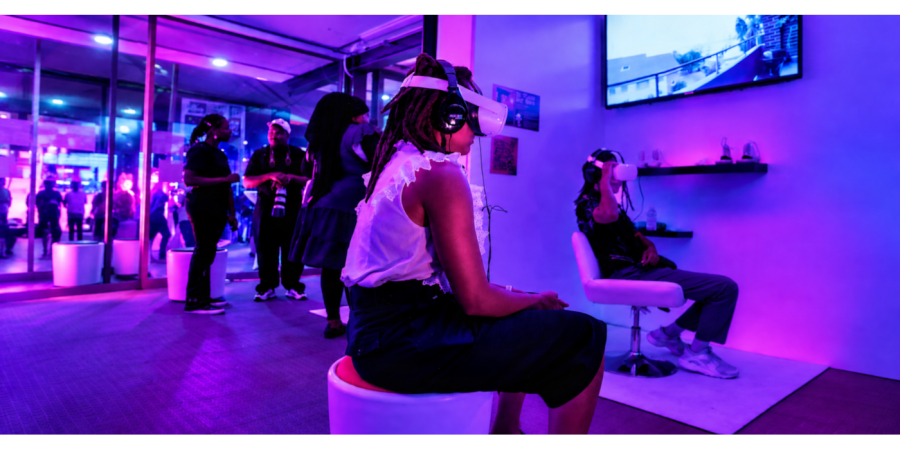
Games approach systems differently. They make rules operational, so participants act inside a system instead of hearing about it. Then “Umfula – Echoes of the River” changes the scale again. At Fak’ugesi, the work is presented as a fulldome film screening at the Wits Anglo American Digital Dome, placing audiences inside a 360-degree journey through the Umfolozi River, combining aerial and underwater cinematography, spatial sound and the river’s own voice. The river carries water, memory and culture while confronting pressure from industrial agriculture, mining and expansion.
Immersion changes the limits of representation. A river can be mapped, measured and reduced to data. Inside the dome, the river surrounds the audience. Scale becomes part of the knowledge. AI can work across enormous bodies of knowledge, finding patterns and producing plausible answers. The harder problem begins when the answer meets something the system has not adequately represented. That something might be a beadwork system that predates digital code. It might be a language, an informal economy, a migrant experience, an ecological knowledge system or a decision made by a person inside a model. Johannesburg makes that problem hard to ignore: world-class research sits beside knowledge that never enters institutional datasets.
The future is already unevenly built.
Representation is therefore a question of agency. Who gets to describe the problem? Who defines the dataset? Whose language survives the model? Whose lived experience gets to contradict the output? Future Engines does not resolve those tensions. It creates situations in which they can be tested. Infrastructure is not only what carries us into the future. It determines what can travel with us, what can remain, and what we might fail to see along the way.
The future is under construction.
The question is who gets to build it, what they are allowed to imagine, and what happens when the model meets the world.
Programme and booking information was correct at the time of publication and is subject to change. Please check the official Fak’ugesi programme for the latest information before attending.
Ashraf Johaardien is the Resident Writer at Fak’ugesi African Digital & Innovation Festival 2026.
Ashraf Johaardien
ashrafjohaardien@me.com
M\e. Creative
Disclaimer: Artslink.co.za encourages freedom of speech and the expression of diverse views. The views published do not necessarily represent the views of Artslink.co.za.