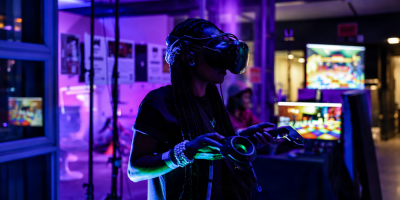
Featured artists interrogate the machine
Ashraf Johaardien: What happens when the machine stops being the tool and becomes the subject?
Three Fak’ugesi 2026 artists are using technology to ask harder questions about images, machines and perception.
AI has become good at making things. For artists, the more interesting question is what happens when the technology itself becomes part of the thing being investigated.
Fak’ugesi African Digital & Innovation Festival returns from 13 to 17 October 2026 in Johannesburg under the theme African Imaginaries, turning Braamfontein and the Wits precinct into a living laboratory. The professional programme is structured around three curatorial frequencies: Memory Engines, Imagination Engines, and Future Engines.
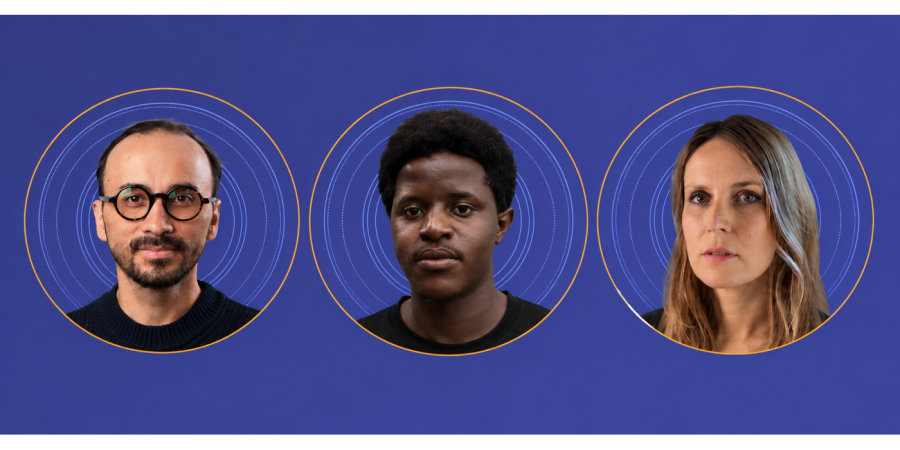
Among its featured artists are three practices that make the technology itself the subject: Ugandan photographer Evans Akanyijuka, Chile-based researcher Dr Renzo Filinich Orozco, and Berlin-based artist Dagmar Schurrer.
Akanyijuka begins with the image.
His practice sits at the intersection of photography, artificial intelligence and authorship, asking how images of Africa are produced and who gets to shape them. He is a multi-media visual artist working at the intersection of photography, collage and emerging media, and a Ugandan visual artist working at the intersection of photography, photo manipulation, collage and artificial intelligence, based in Kampala, Uganda.
His bodies of work include Stillness (2024), emotional mapping through an AI character, and LoRA as an Archive, A Living Archive, developed for the ZaZi challenge within the S+T+ARTS Afropean Intelligence Residency with Market Photo Workshop in Johannesburg.
The significance is not that AI is involved. It is that tools built elsewhere are being remade through an African artistic practice. Akanyijuka describes his approach this way: “I found I could say things with creativity and through manipulating photos that I had no words for.” The technology is not the master. It is a language through which he speaks what photography and collage alone could not carry.
Image-making is never neutral. Photography participates in deciding what becomes visible and how people, places and histories are represented. Generative systems add another layer, drawing on vast bodies of visual material while obscuring assumptions within them.
Renzo Filinich Orozco turns the question around.
His work includes Quantum Echoes of Humanity, an interactive installation with AI developed as a joint project with LabInter at the School of Digital Arts, Wits University and Art Center, Federal University of Santa Maria, and Echoes of the Machine: A Cybernetic Song, an interdisciplinary artwork exhibited at the Origins Centre, Wits, in February/March 2026. He has collaborated on projects such as Quantum Echoes of Humanity, which engages artificial intelligence and anthropological data to reimagine the Anthropocene from the Global South.
His practice as researcher is based in Chile, with work developed at the University of Valparaiso and Faculty of Arts, University of Arts, Sciences and Communications in Santiago, Chile.
This is not a demonstration. It is an experiment. The encounter becomes a way of finding out what the system does, what it can register, and what remains outside its perception. The machine is no longer just a tool. It is part of the question. Presented as a living lab, failures are part of the work.
Dagmar Schurrer brings the question back to the human body.
Her practice moves across expanded animation and extended reality technologies, linking (Neuro-) sciences, new technologies as XR and Artificial Intelligence, digital world-building and poetic interpretations of human consciousness and its environmental entanglements. She is an Austrian new media artist based in Berlin, Germany, working in the field of expanded animation and extended reality.
At Fak’ugesi, she appears on Thursday 15 October, Imagination Engines, the festival’s AI anchor day at the Chris Seabrooke Music Hall, presented with the Wits Machine Intelligence and Neural Discovery Institute. Her conversation “Same Prompt, Different Planet” is scheduled for 15 Oct, 12:45–13:15, at Chris Seabrooke Music Hall.
The title carries the proposition: a prompt can be identical. The encounter with it is not.
You sit in front of the same interface. You type the same words. What emerges depends on who is typing, what assumptions you carry, what visual language you know and what problems you are trying to solve. The interface does not flatten those differences. It reveals them.
As Schurrer explains: “The moving image is the main concern of my artistic practice.” Within that frame, she assembles imagery, text, drawing, abstract colour elements and sound to form intricate montages, with all elements treated as equal layers. Within that frame, AI is one layer among others, not the determining one.
AI is often presented through the language of universality. But artistic practice returns us to situated experience. From where are you speaking? With what knowledge? Toward what end? Schurrer’s work extends the question from what machines produce to what technologies do to perception.
Taken together, these three artists describe a different way of thinking about AI at a festival.
Akanyijuka asks you to look at the image and trace its provenance.
Filinich Orozco asks you to listen to what the machine hears.
Schurrer asks you to notice what happens to your own perception when the interface becomes part of the experience.
That sequence matters for Fak’ugesi. The festival moves through Memory, Imagination and Future, while its AI strand sits alongside immersive and XR work, gaming, film, music and sound. The result is not a technology showcase. It is a cultural environment in which technologies can be tested, questioned and encountered on terms that are not their own.
Artists can ask questions that a technology product cannot ask about itself.
What assumptions are embedded in the image? What does the machine fail to perceive? What happens to human perception when the interface becomes part of the experience?
These questions do not require AI to be either celebrated or condemned. They require attention.
Fak’ugesi’s featured artists are not showing what AI can make. They are showing where the technology becomes uncertain: at the boundary between image and author, machine and perception, prompt and experience.
And that is where the work becomes difficult. Not because artists have the answers, but because they can make the questions real enough to stay with you for longer than the exhibition.
Ashraf Johaardien is the Resident Writer at the Fak’ugesi African Digital & Innovation Festival.
Ashraf Johaardien
ashrafjohaardien@me.com
M\e. Creative
http://www.fakugesi.co.za
Disclaimer: Artslink.co.za encourages freedom of speech and the expression of diverse views. The views published do not necessarily represent the views of Artslink.co.za.