Provenance
Ashraf Johaardien: A brief meditation on the frontier between what a body knows and what a mind can name.
Provenance
I wrote this Heritage Day social media caption for a post in one draft:
The future will inherit what we make now.
I meant it as inspiration. But as I was writing it, I realised I was also thinking about a play I had been making for nearly two years.
Yesterday, I submitted the full draft of “Provenance” to Lesley Wright. A year of writing and development completed as Resident Writer at Fak’ugesi since April, now ready for its first public presentation. At almost exactly the same time, I was chasing a Sunday midnight festival submission deadline. One piece of work was finally leaving me. Another was still demanding to be made.
The heritage caption kept reaching backwards. Not to a single origin, but to conversations about what my daughters will inherit, about what gets transmitted in a joke or a gesture. Ostensibly, the caption was about culture. But I kept thinking about a body. About what a body remembers that a mind hasn’t yet named.
This is what Monday morning sounds like after beating my midnight deadline by three minutes.
The invisible load.
Wet dreams dry in the sky.
Holy wafer in the cerulean blue wine.
Metaphor is not for everyone Perhaps that’s the point. Provenance usually means origin: where did this come from? But the word itself moves differently. From Latin ‘provenire’, to come forth, arise. Pro, forth. Venire, to come. Something doesn’t simply have a provenance. It comes forth.
That became the starting point for a a theatre work about a comedian called Alec trying to establish what in him is actually his. The piece comes to IBM Lab at the Tshimologong Digital Innovation Precinct in Braamfontein on 15 October 2026 for its first public presentation.
A joke comes from Alec’s fiancée. A posture comes from his father. A fear comes from childhood. A body remembers something the mind has decided is over. An image of Alec comes from Gemini and looks enough like him to be plausible while being recognisably not him.
His fiancée tells him, “You never asked whether it was yours to tell.” He tells her he never uses her name. “Through me. Not the same thing.”
Something can come through you without coming from you. In the play, this isn’t only a question of authorship. It becomes a question about the body.
A measuring tape lies on the floor. Alec picks it up. His father used it the same way, holding it at shoulder height, speaking while measuring. Alec doesn’t remember learning this. His body learned it. The audience sees the repetition before Alec does. The metaphor isn’t in the words. It is in the body replicating the father’s posture without permission or awareness.
This is where metaphor became useful to me, not as decoration but as a dramatic technology. I don’t mean that the giraffe in the play represents trauma, or that falling stands for fear. That would make metaphor a code in which one thing is secretly another thing. I am more interested in what happens when the metaphor arrives before the explanation.
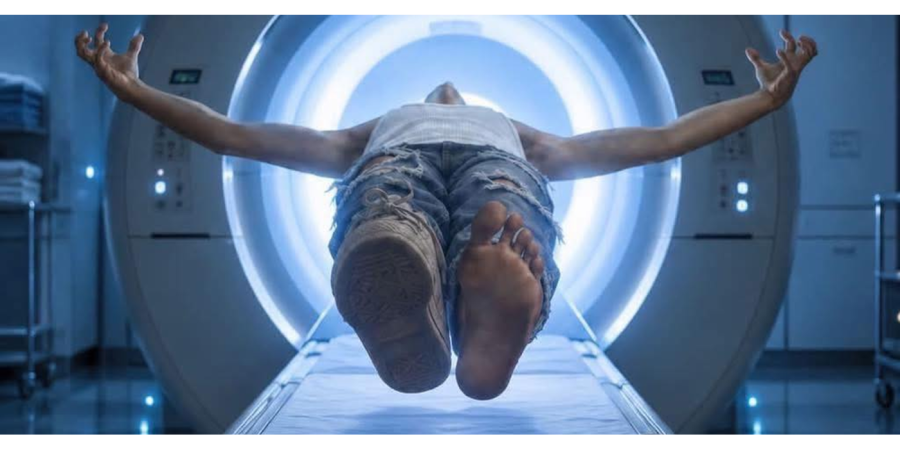
Alec is seven years old, lying in a garden in Grassy Park. A blue beam descends. There are aliens. There is a giraffe. Decades later, his adult body still flinches at the word giraffe. He cannot access why. Instead, the trauma breaks apart into physical fragments. Shoulders tense. Breathing changes. A body flinches. A bottle is held too tightly. Swimming, falling, changing rooms, counting. The narrative cannot yet reassemble them. The body can.
Metaphor here doesn’t represent trauma. It scatters it into fragments the body recognises before language catches up. David Whyte writes that injury forces us into metaphor because it shatters our sense of self. That is the theatrical problem I was trying to solve. Poetry, for Whyte, is “language against which you have no defenses.” In the play, metaphor is that frontier – held open between what a body knows and what a mind can say. Which is why the play resists plot. A plot would suggest that Alec discovers something and changes. Instead,
Provenance is structured as a sequence of recognitions: moments when his body, memory, inheritance and systems become perceptible through metaphor rather than despite it. A timetable becomes the gap between what a system promises and what a journey actually does. A mirror produces an image that is recognisable and strange. An AI system produces a version of Alec that looks successful, dignified, plausible. His daughter looks at it and says, “That’s not you.”
On stage, Alec watches a version of himself being reproduced and recognises the image as simultaneously false and plausible. That’s the frontier now. We are living through a moment when human material is being copied, modelled, generated and returned. Provenance of an image, sentence or idea becomes harder to establish when what comes next contains traces of many earlier things.
A joke through a lover. A gesture through a father. An image through a machine. What enters as human material comes back as something else.
“The future will inherit what we make now.” I meant that as a Heritage Day caption. I think I also meant it as a warning. Not about AI. About the fantasy that what we make disappears. It doesn’t. It comes forth. Through people, bodies, machines, art.
By the final scene, Alec stops asking, “Whose is this?” and starts asking what happens as things move through him. The play doesn’t answer. It traces. That tracing is the metaphor. By the end, he doesn’t discover a single source. The insight rearranges the mess that was already there.
Maybe that is what provenance finally means to me. Not a clean origin story. A thing coming forth through a body. Through a joke, a posture, a flinch, a fear that arrives before words arrive.
Metaphor doesn’t explain the wound.
Maybe it gives the wound a way to move.
Ashraf Johaardien is the Resident Writer at the Fak’ugesi African Digital & Innovation Festival.
Ashraf Johaardien
ashrafjohaardien@me.com
M\e. Creative
https://ashrafjohaardien.com/portfolio
Disclaimer: Artslink.co.za encourages freedom of speech and the expression of diverse views. The views published do not necessarily represent the views of Artslink.co.za.