Andulela
Ashraf Johaardien: What comes before is not empty. It is where things begin: in language, images, rooms, machines and assumptions we rarely stop to question.
Once again.
The season is changing. A threshold crossed before anyone has decided. Time to trade the cobalt faux bear fur robe for the white linen boy kimono.
The house holds the shape of where they are not this morning. Avian complaints ring through the windows onto the lake, the birds unaccountably loud, as if they too have noticed the house is short a few people.
Fak’ugesi 2026 is both already a festival and not yet a festival. The website exists. The programme exists. Several live campaigns exist. Xo exists. People are making things for rooms that will not hold them for another six weeks. This is the part before.
I have worked with enough arts institutions to have stopped noticing their names, which is another way of saying I stopped noticing English. English was already there. Waiting. Doing the naming before anyone thought to ask it to.
Now Fak’ugesi, and the language itself becomes a question. What does it mean. Why that name. Isn’t it a curious choice for a festival.
The question underneath that one interests me more. Why does a festival carrying a Zulu name require explanation at all?
I have reached for other languages for years. French. Arabic. Japanese. IsiZulu. Not out of any polymath instinct. I am not a polymath. I reach because my English runs out somewhere short of what I’m trying to hold, and another language sometimes arrives already having done more of the thinking.
Fak’ugesi is a word like that. An English title would need a paragraph to do what Fak’ugesi does in four syllables, and then the paragraph would need explaining too.
The word is already doing the work.
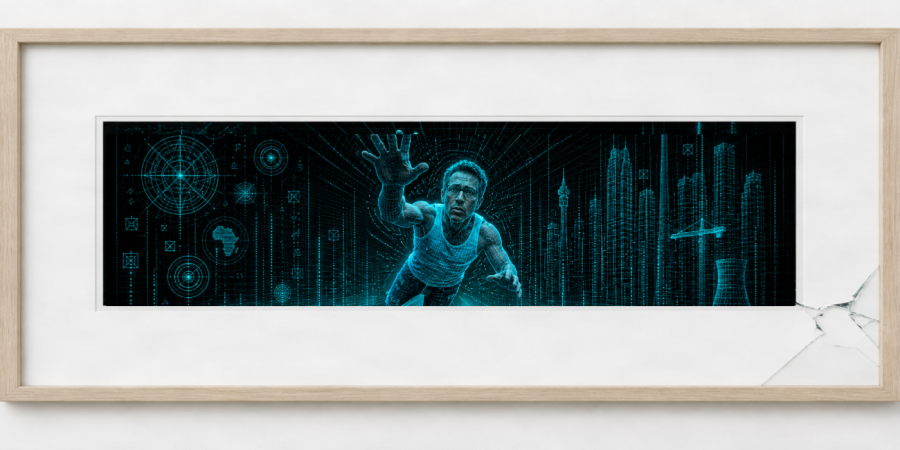
This is what interests me about the gefuffel over AI posters. Who made it, whether it’s any good, whether an artist was displaced, whether an institution should be using a machine to make an image for an arts event. These are real questions, but there are other ones sitting underneath them that go mostly unasked.
Why do we agree on what a poster is for, who should make one, what professional visual communication is supposed to look like, why an institution’s own name almost defaults to English in a country with eleven official languages.
Normal is a powerful word. It can make an assumption look like a fact.
The festival designer made Xo without AI assistance. The mascot for this year is fully human-made. I took Xo afterward and asked a machine to imagine her differently, which is a smaller claim than it sounds like. I wasn’t asking the machine to make the mascot, only to receive something a person had already made and see what happened when it passed through a different kind of making.
Then my daughter drew something, and I asked the machine to read her drawing as a blueprint for the future. The child and the drawing arriving first every time. The machine only ever interpreting what was already there.
Sometimes interpretation is translation. Sometimes it is an argument. Sometimes it is a distortion. Sometimes it is a possibility.
None of this settles the questions about AI. If anything it complicates them. What is the author when an image has passed through several hands and one machine. Where does the idea begin, with the person who draws, the one who prompts, the one who selects the output, the institution that gives the image a place to live.
We are good at questioning the new thing and less good at questioning what the new thing has disturbed on its way in.
Fak’ugesi’s own language is doing this work too. Khumbula, remember. Cabanga, think, imagine. Isasa, tomorrow. Not simply metaphorical labels for the three programme frequencies. Rather, they are a movement. A score. Remembering what matters. Imagining what can be built from what’s been carried forward. Thinking toward what comes next.
Andulela sits somewhere in that movement without being another engine. It names the condition before the thing. What prepares the way. What is already happening before anyone has agreed to call it begun.
The festival is in that condition now. Still a scary few weeks away and also already everywhere, in documents, screens, conversations, images, names, in things being made and things being rejected, in rooms being readied for people who aren’t there yet.
My husband and the girls are still in Macau. The birds are still going on about something. The festival still hasn’t happened.
But something has..
Not an empty space before the thing.
The thing already beginning.
Andulela.
Ashraf Johaardien is the Resident Writer at the Fak’ugesi African Digital & Innovation Festival. M\e. is his practice, spanning research, systems design, and publishing, developed with commercial partner Joanne Walters.
Ashraf Johaardien
ashrafjohaardien@me.com
M\e. 風芽
http://www.ashrafjohaardien.substack.com
Disclaimer: Artslink.co.za encourages freedom of speech and the expression of diverse views. The views published do not necessarily represent the views of Artslink.co.za.